anthemtour blog

  • Subscribe to our RSS feed.
  • Twitter
  • StumbleUpon
  • Reddit
  • Facebook
  • Digg

Sunday, 21 October 2012

Pick Your Flick And Acquire Spanish

Posted on 00:58 by the khali
Every Spanish-fanatic worth his grain would agree that the slowest means of acquiring Spanish is relegating the process to textbooks and whiteboards. Spanish is a language. An alive one at that. So, live it; indulge in it! One can’t stress enough the importance of breathing life into an otherwise highly unproductive regimented style of learning Spanish as institutionalized by the classrooms. So, as stated previously already, silent input for the win here! The advocates of immersive learning all unanimously underscore the importance of Spanish cinema as an extremely effective way of absorbing authentic real-world Spanish.

Why movies?


Spanish language cinema is rich in inspiring content
Photo credit: Marco Antonio Torres licensed CC BY-SA 2.0
There’s no denying the fact that the easiest and most effective means of breathing life into learning Spanish is by watching tons and tons and tons of Spanish movies. In loop. Over and over again until the dialogs come to you effortlessly. Movies not only inspire a genuine cultural interest in Spanish but also stir up your motivation to nail the language as quickly as practically possible.

Now the question is, what renders cinema this effective when it comes to learning Spanish? The reasons are many and the single most important one is their entertaining nature. No points for knowing that anything that is entertaining stays with us longer. We have a very selective that tends to discard anything insignificant and, at the same time, instantly absorb anything that is weird, interesting, larger-than-life, or just plain engaging. Anything that stirs up our emotions is guaranteed it’s spot in some of the most active quarters of our mind. And movies, without doubt, qualify in all aspects. They not only entertain, but also provide the ever important context for the Spanish that we absorb subconsciously while watching them repeatedly. This context acts as the cement that binds those newly-acquired dialogs and vocabulary firmly to our memory.

Where do I begin?


Spanish language films are more diverse than you thought!
Photo credit: Martha Silva licensed CC BY-SA 2.0
While every linguist and Spanish enthusiast I have spoken with to date has been unanimous on the role of Spanish movies in helping one acquire natural Spanish quickly, most learners are often clueless about where to begin. There are tons of flicks to choose from and then there are dozens of different Spanish dialects making the choice even more difficult. This article is an attempt to simplify this first step for Spanish learners who wish to be bewitched by the vast linguistic riches of Spanish cinema from both sides of the Atlantic.

My idea of an ideal movie for someone learning Spanish is that it should meet some very straightforward criteria to begin with. This movie should be
  • Engaging – If the story engages you, you are more likely to remember the context. This also means that you are more likely to enjoy watching the same movie for the thirty-sixth time if you find it engaging enough.
  • Powerful – If the story gives out a strong message (social, political, etc.) you are going to remember it frame-by-frame.
  • Popular – If everyone around you knows about and likes the flick, you are likely to hear about it more often which would, in turn, reinforce the story in your memory as well as drive you into a repeat watch.
  • Authentic – The single most important aspect of an eligible movie is that the cinematography and direction must reflect the real-world Hispanic lifestyle and culture as accurately as possible. This will ensure that you absorb the context more rapidly.
Keeping these caveats in mind, the following sections list out some of the most recommended films from as many as 8 countries that speak Spanish. Our suggestion would be to first decide the country whose flavor of Spanish you intend to acquire and then pick the flicks from that country to ensure you are absorbing the right dialect. This extra step will serve to maximize the benefits of watching Spanish movies in endless loops.

Argentina


Anita

Bajo Bandera

Casas De Fuego

El Asaltante

El Día Que Me Amen

El Hijo De La Novia

Fuerza Aérea Sociedad Anónima

La Niña Santa

La Mujer Sin Cabeza

La Señal

Las Manos

Las Viudas De Los Jueves

Los Siete Locos

Mal Día Para Pescar

Memoria Del Saqueo

Plata Quemada

¿Quién Dice Que Es Fácil?

Un Lugar En El Mundo

Una Estrella Y Dos Cafés

Volver

Chile


Cien Niños Esperando Un Tren

Dulce Patria

Julio Comienza En Julio

La Batalla De Chile

La Esperanza

La Nena

No Me Amenaces

Raíz De Chile

Colombia


Cóndores No Entierran Todos Los Días

La Estrategia Del Caracol

La Sombra Del Caminante

La Vendedora De Rosas

Perro Come Perro

Rodrigo D: No Futuro

Cuba


Baragua

Clandestinos

De Cierta Manera

El Otro Francisco

El Rojo Para Los Labios

Gallego

Hasta Cierto Punto

La Muerte De Un Burócrata

La Última Cena

Lejanía

Los Sobrevivientes

Mujer Transparente

Retrato De Teresa

Un Hombre De Exito

Vals De La Habana Vieja

Ecuador


Crónicas

Cuando Me Toque A Mí

¿Qué Tan Lejos?

Ratas, Ratones, Rateros

Sueños En La Mitad Del Mundo

Mexico


Amores Perros

El Callejón De Los Milagros

El Crimen Del Padre Amaro

El Laberinto Del Fauno

Japón

La Muerta En Este Jardín

Luz Silenciosa

Santa Sangre

Subida Al Cielo

Y Tu Mamá También

Nicaragua


Alsino Y El Cóndor

Bananeras

Cinema Alcázar

Con Ánimo De Lucro

De Niña A Madre

El Chogui

El Espectro De La Guerra

El Inmortal

La Insurrección

Metal Y Vidrio

Spain


Abre Los Ojos

Boca A Boca

El Crimen De Cuenca

El Pájaro De La Felicidad

El Orfanato

La Ardilla Roja

La Lengua De La Mariposas

Mar Adentro

¿Qué He Hecho Yo Para Merecer Esto?

Solo Quiero Caminar

Todo Sobre Mi Madre

Uruguay


Caños

Cariñoso

Cerro Corá

El Baño Del Papa

El Último Tren

La Espera

La Esperanza

Llamada Para Un Cartero

Matar A Todos

Paisito
Read More
Posted in Movies and Shows | No comments

Saturday, 20 October 2012

The Laziest Way To Conquer Spanish

Posted on 10:04 by the khali
What’s going to be under discussion today is set to radically and fundamentally change the way you approach the Spanish language as a learner. To most purists, this article should read as nothing short of an academic blasphemy but if you manage to believe what we believe and what’s backed by solid, empirical study, acquiring Spanish or any other language of the world is not for the serious learners. The lazier you are, the easier it gets for you; best if you dig all things that come to you on a platter without any effort whatsoever on your part. Stumped? Bear with us and you’ll soon see the inherent sense in this nonsense.

Dr. Krashen’s input hypothesis


Get a crazy amount of input before you start speaking Spanish
Photo credit: Tim licensed CC BY-SA 2.0
The wonder drug this article hinges on is a philosophy in linguistics known as the “input hypothesis”. This is essentially a bunch of 5 hypotheses rolled into one, the gist being that the one and only way to the Holy Grail (read native-level fluency) of language-acquisition is getting smothered by an overwhelming amount of input (reading and listening) in the target language (Spanish in our context) without producing (speaking, talking, etc.) any bit of it at all for at least the initial phase.

In case you are wondering how fluency could ever be attained, without even practicing the Spanish that you absorb during the input, look no further than your very own childhood. Don’t forget that you didn’t utter a single word of your native lingo for a good two years or so while solely being bombarded with constant input from around you. Did that help? Well, it must have done a hell of a job as it is nearly impossible for you to now forget your mother tongue after those years of foundation-building!

If this is still not solid enough reasoning to win your vote, let me tell you where this hypothesis came from. It is a world-renowned linguist and educator who goes by the name of Dr. Stephan Krashen. The fact that he has published over 300 books and research papers in the field of second language acquisition and that he goes to the University of Southern California as a Professor emeritus, should be enough to tell you that this man means business.

How much input is enough input?


OK, now down to the brass-tacks. So, how is this “input hypothesis” to be applied to your leal life Spanish program? Well, it couldn’t get any clearer; the first and the most important thing is to build the ultimate immersion environment around yourself and get an insane amound of input in Spanish, day in and day out. It is also equally important that you set your mind around “acquiring” Spanish and not “learning.” This step is deceptively simple so be careful. What acquiring means is what we did with our mother tongue when we were toddlers. To your Spanish program it means that you shouldn’t calculate how much time to dedicate to Spanish if you want to acquire it. Acquisition cannot be a deliberate activity. It has to be infinitely immersive.

Listen to hours of Latino music, read pages and pages of Spanish novels and newspapers, watch hours of Spanish videos, movies and telenovelas. Essentially don’t attach a rock-solid timeframe to any of these activities. Spanish should flow freely in your world. If your assign hours to any of these activities, you are mostly setting yourself up for failure. Instead of targeting to listen to Spanish music for an hour everyday, you should be targeting listening to only Spanish music whenever you listen to music, regardless of how long. Similarly, I wouldn’t instruct myself to read El Universal® for 30 minutes a day; instead, I will mandate myself to pick El Universal® (or, El País® or some other Spanish paper) and nothing else every time I wish to read a newspaper. This is how Spanish becomes a part of your life. This how Spanish becomes your life. This is how you acquire Spanish. by first allowing Spanish to acquire you!

The worst approach


As if conspiring to keep us from ever becoming bilingual, our schools and colleges have always stressed on grammar and vocabulary like our life depended on them. We are institutionalized to first study and “master” the billion rules of grammer before we open the taps of Spanish input. And then the traditional next step as dictated by academicians around the world is to produce content in Spanish (poetry recitation, forced conversation, essay writing, you name it). Only once we have done a certain amount of output as mandated by our teachers, are we introduced to extensive input, such as reading Spanish stories, listening to Spanish music, well, basically all the fun stuff we can imagine. The sequence is so perfectly reversed that it almost seems deliberate!

The right approach


The natural order of things should be exactly the reverse of what we traditionally do in schools. So, the first step becomes tons and tons of fun stuff in a phase called “input phase”. Just listen and read and listen and read. No talking, no writing, no essays, no recitations. The ultimate couch-potato’s promised land of milk and honey! Only once comfortable with this phase (your comprehension abilities will tell you, don’t worry about when), it’s time to start producing. Imitate native speakers, recite Spanish poetry, sing Spanish songs, write Spanish essays, talk in Spanish, chat in Spanish.

In short, just barf out all the Spanish that you have been acquiring through silent input over all these months. The last step, interestingly, happens to be grammar. Yes, you were speaking fluent English (or whatever your native tongue is) way before those monsters buried you under piles of grammar rules. Grammar is never the be-all of any language. It should only be a tool used to perfect your speech and writing once you are well-versed with the language in every practical sense.

Grammar is indispensible. It is grammar that gives a literary flair to your Spanish. It is grammar that tells you how Spanish changes colors when moved from the books to the streets. But the right time to scratch under the surface for grammar is in the end and not in the beginning. A sufficient amount of input is all you need to be able to tell what word sequence sounds correct and what doesn’t.

So, strap your boots and dive head-on into the ocean of Spanish before you even think of grammar. until you are conversant enough, stow that heavy, red book away – out of sight, out of reach. Just take in the Spanish around you. Soak it all up. Have fun. And enjoy as you get fluent phrase by phrase, word by word, absolutely unaware. Think of a lazier way to acquire Spanish? I bet you can’t.
Read More
Posted in Immersion | No comments

Wednesday, 17 October 2012

Learn Spanish In A Sentence

Posted on 09:36 by the khali
Acquiring Spanish (read Spanish vocabulary) is most efficient when done in context. The importance of color a context lends to any new word or phrase and its role in long-term retention just can’t be stressed enough. In order to illustrate this today, we will pick a very simplistic yet practical idea which will not only help you learn new words but also make it easier for you to absorb some essential Spanish grammar without memorizing a single dead-beat rule from that spooky grammar tome. All this as you also gradually get a fair understanding of some fun and interesting trivia on Latino culture. Three birds, one stone!

Ojos que te vieron ir...
Photo credit: Rob Marquardt licensed CC BY-SA 2.0
The method we will be introducing here is not a new discovery. It’s rather a very simple and extremely effective technique lost in the rubble of classroom grammar and dictionary word-lists. The idea is simple: We pick an inconspicuous Spanish phrase or sentence and perform a thorough autopsy on it showing all aspects of its usage, including meaning and grammar.

In order to make the whole exercise more interesting and culturally relevant, these sentences will often be local piropos (pick-up lines), refranes (proverbs), or excerpts of street conversations. This way, the context will not appear bookish as it does in most books that claim to get you from zilch to fluent in Spanish in a few weeks.

Let’s start wth today’s piropo which goes like this (The sense interpreted is given in parentheses and may or may not be the literal translation):

Ojos que te vieron ir, ¿cuándo te verán volver? (Eyes that saw you leave, when will they see you return?)

The nuts and bolts


Let’s break it down, perform the autopsy. For this, it is important that we first see how this sentence literally transliterates and then use some reverse engineering to understand why words are strung together in the fashion they are.

The sentence transliterates as, “Eyes that you (object) saw go, when you (object) will see return?” Hardly makes any logical sense, right? Bear with me for a few minutes and you’ll see just how smoothly words flow right in place. Here we go:

Ojos: This is the Spanish for “eyes”. Ojo is the singular form but since we are talking about both the eyes here, we say ojos. Simple, wasn’t it? Just use visualization to remember this word and you are through. Or, if that doesn’t suit your taste, try flashcards or Anki. It’s not difficult when you break it down.

que: This simply translates to the English word, “that”. Don’t confuse this with qué which means “what” of English questions. So, qué (with that little spike above “e”) is “what” (as in, “What is your name?”) and que is “that” (as in, “The ball that hit me”); qué for questions, que for answers. Hope this didn’t hurt much.

te: This is the Spanish for “you” when used as an object. The English word, “you”, is tú when used as a subject (as in, “You should leave”) and te when used as an object (as in, “I love you” or “She gave it to you”). See the difference? The rules of Spanish dictate that objects like te be immediately followed by the verb affecting them. That’s the reason the most overused Spanish phrase, te quiero (I love you) has te followed by quiero (I love) and not the other way around as is the case with it’s English translation.

vieron: The Spanish for “saw”; The English verb, “to see”, translates to ver in Spanish but because Spanish is a highly inflected language (has a lot of conjugations), ver is rarely used in its basic form (infinitive). So, while the Spanish for “to see” is ver, the actual word used in a sentence will depend on the tense and mood of the context. Here, we are talking about the eyes seeing you leave once in the past (only once and not repeatedly or habitually), so the form of ver used is vieron. If you must dig into the rules of grammar governing this usage, grab your grammar book and read all you want on the preterit tense. Now back to our vieron, this is the word you’ll use whenever the subject is plural (like “two eyes” in our sentence today) and the action is a one-time event in the past (like the eyes that “saw” you leave “only once” as implied in our sentence).

ir: The Spanish for “to go”; this is an example of a verb being used in its most primitive form also known as the “infinitive”.

cuándo: This is how you say “when” in Spanish when asking a question (as in, “When are you going?”). Again, don’t miss the accent mark without which it becomes cuando, meaning when in a non-question sense (as in “I will go when she comes”).

te verán: We already discovered that the Spanish word for “to see” is ver. And we also learned that it is almost always used in one of the many conjugated forms depending on the tense. Verán is simply the form to be used when talking about an event in future performed by more than one subject. Here, we are talking about two eyes so the subject is plural and the verb to be used is ver, hence verán qualifies as the form to be used in this sentence. We already learned that te is the Spanish for you in its object form and that objects come before verb in question, so the Spanish for “will see you” is te vieron (the subject being understood to be plural).

volver: This word means “to return” in it’s basic form (one important tip for identifying any Spanish verb in its infinitive form – all such words end in “-ar”, “-er”, or “-ir”).

String’em all together


Now let’s bring them all together. Ojos que te vieron ir means, “Eyes that saw you go,” in the following sentence structure common in Spanish: Subject (plural; here, “eyes”) - connector (here, “that”) - object (singular; here, “you”) - verb1 (here, preterit of “to see”) - verb2 (here, infinitive of “to go”). ¿cuándo te verán volver? means, “When will they see you again?” in the following sentence structure in Spanish: Question word (here, “when?”) - object (singular; here, “you”) - verb1 (here, future of “to see”) - verb2 (here, used in the sense of “again”)

We hope this one sentence has given you enough dose of Spanish for one day and taught new words and new grammar without jagging your brains like those boring books you are dumped with in the classrooms do.
Read More
Posted in Deconstruction | No comments

Tuesday, 16 October 2012

Does Messi Speak The Spanish Of The Illiterate?

Posted on 11:57 by the khali
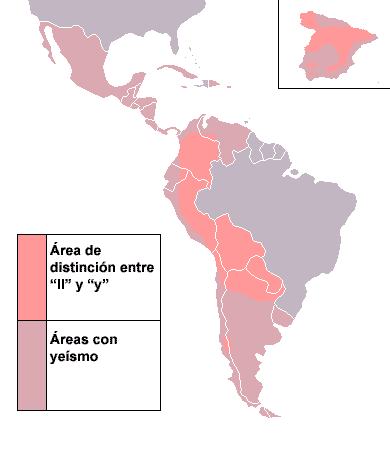
Most textbooks claiming to teach easy Spanish would have you believe that the letters “y” and “ll” are pronounced the same in this language and that the sound they carry is that of “y” in “yellow” in Latin America and that of “llio” in “bullion” in Spain. But in reality, native Spanish language is far from this simplistic picture. This language was not born with similar-sounding “y” and “ll”; on the contrary, early Spanish mandated that “y” be pronounced as the “j” in “jug” and “ll” be pronounced as “y” in “yellow”. Centuries of permutation and combination meant that this distinction blurred almost completely – almost.

Does “y” always sound like “ll”?


Spanish pronunciation: Yeísmo
Yeísmo in America
Photo credit: Davius licensed CC0 1.0 Universal
Yes and no. The distinction between “y” and “ll” in Spanish has almost disappeared today except for some minority pockets such as the rural north in Spain and the indigenous-dominated regions (particularly, Quechua-heavy areas) of Latin America. Today’s Spanish-speakers have a whole range of sounds they attach to their “y” and “ll” and how they pronounce these letters often tell where they come from and what their cultural background is.

Today, we will see how this works in Argentina. Why Argentina? Because these letters don’t see as much diversity in their pronunciation in any part of the world as they do in Argentina.

Pronunciation of “y” and “ll” in Argentina has been the subject of many serious researches and surveys and because of the extremely fluid nature of Spanish in today’s world, these regionalisms may or may not hold water in times to come. Hence, please read this article with a pinch of salt and do not treat these demarcations as etched in stone. Just see them as the state of affairs as of today, more or less. No language, let alone Spanish, can be declared to have a rigid accent-region association at all times; this can only be approximated at best.

Argentina: One country, many pronunciations


Most Argentineans pronounce these letters as either “sh” in “sheep” or as “s” in “measure”. You’ll rarely hear an Argentinean use the “llio” (of “million”), “j” (of “jello”) or “y” (of “yellow”) sound. Now the question that arises is which one, “sh” of “sheep” or “s” of “measure”? One study suggested once that this is a matter of education or, more significantly, social class. Those in the lower strata of the social hierarchy tend to veer in favor of “sh” of “sheep” while the more elite, educated class prefer “s” of “measure”.

The story doesn’t end here. Delve deeper and more shades of gray start popping out. For example, even the Porteños (residents of Buenos Aires) have a wide range of pronunciation. Most primary school teachers are heard teaching the “llio” of “million” for the letter, “ll”. This is deliberate and affects only “ll” and not “y”. The reason could be to reinforce the phonetic distinction between “y” and “ll” and help the children learn which word takes which letter.

This distinction, more often than not, diffuses with age and hardly any grown-up conversation is heard pronouncing “ll” as the “llio” of “million” anyplace in Buenos Aires. While most of Argentina follows the above-mentioned pronunciation, some indigenous people and those in the north-western parts do use the “y” sound of “yellow” for the Spanish “y” and “ll”, in line with the rest of (or rather, most of) Latin America.

Where are we headed?


Messi pronounces his “ll” as /sh/ like most others of his generation
Messi pronounces his “ll” as /sh/ like most others of his generation
Photo credit: Adam Jones licensed CC BY-SA 2.0
To push us farther from closure, modern studies have also shown a new trend where the socio-educational distinction described above is rapidly giving way to a new, generational distinction. What this means is that while the fact that the elites prefer the “s” of “measure” while the uneducated prefer the “sh” of “sheep” did hold good some three decades ago, it doesn’t today.

Today, the trend is for younger Porteños to prefer the “sh” of “sheep” regardless of educational or social background while those of the older generation prefer the other pronunciation, i.e., “s” of “measure”. Endorsing this theory, the famous Argentinean soccer legend, Lionel Messi pronounces his “ll”/“y” as the “sh” of “sheep” despite being quite bit of an elite. Even if you consider the fact that Messi comes from Rosario, some 180 miles from Buenos Aires, it is still within the sphere of common linguistic influence known as the Rioplatense dialect area.

The indigenous influence


It is true that an overwhelming majority of Spanish speakers around the world, including those from Argentina, today don’t recognize the distinction between the Spanish “y” and “ll”. However, there are some exceptions to the rule even today. In Argentina, these people mainly come from the provinces of Corrientes and Misiones. Those from Corrientes pronounce their “y” as the “j” in “jello” and “ll” as the “llio” in “million”. The Misioneros, however, pronounce their “y” in a fashion that approximates the English “ch” sound. This could be attributed to the Guaraní influence on their speech. Nevertheless, barring these folks, as stated above, almost every Argentinean is a yeísta (one who doesn’t differenciate between the Spanish “y” and “ll”). Furthermore, the natives of Cuyo, Córdoba, and the Mesopotamia regions don’t use the “s” and “sh” sounds of “measure” and “sheep” respectively!

These idiosyncrasies of Argentinean Spanish are not meant to put you off-base with information overload. They are here only to demonstrate the extremely volatile nature of Spanish and give you some fun trivia. As far as your learning is concerned, you just need to focus on the way these letters are pronounced in the specific dialect of Spanish that you are targeting. If you don’t have any particular dialect on your mind (it is highly recommended though that you choose one right at the onset; you’ll only thank yourself later that you did), you’ll be understood everywhere in the Milky Way if you just use the “y” of “yellow” or “j” of “jello” for both “ll” and “y” in all contexts.
Read More
Posted in Street Spanish | No comments

Forget Boring Word-Lists

Posted on 00:56 by the khali
How many of us have spent countless hours reading and memorizing long lists of uninteresting words in Spanish along with their English meanings and craved for an alternative to this monotonous, highly regimented way of learning Spanish? I bet most of us have. And out of personal experience, I must say this is the least effective way of acquiring new vocabulary in any language, Spanish being no exception. It is just too much work with too little fun, not to mention the risk of forgetting them that still looms large. So much for the hard work and dead-beat monotony of a regimented learning style! So, what’s the alternative?

Why are word-lists ineffective?


Mugging up words in isolation is infinitely ineffective
Photo credit: kafka4prez licensed CC BY-SA 2.0
Other than the monotony that comes with mugging up lists after lists of Spanish words, there are two major demerits to this style of learning Spanish. For starters, our conversations are not lists of words; they are meaningful strings of words and phrases called sentences that are used in a context that essentially dictate their meanings.

Secondly, mugging up words out of context is never a sure-fire way of committing them to memory in the long run; such words are highly prone to being forgotten. The keyword here is “context”. Without context, everything is meaningless and all efforts are wasted efforts.

For example, let’s take the word, ir (to go). You have written down this ever-important word in your notebook, in your flashcard, in Anki®, everyplace and have revised it over and over again say, a thousand times until you remember that ir means to go. Now, let’s put this newly-acquired vocabulary to some good use. Try saying, “I am going to the bank” in Spanish (voy al banco). Given that you already know that the subject (here, yo) is omitted in Spanish, that “to” loosely translates to a in Spanish, that the Spanish for “the bank” is el banco, that a and el when together become al, and that the Spanish for the English verb, “to go” is ir, you will most likely not be able to think this sentence in Spanish and be spontaneous with your rendition the way fluent natives are. Reason? You translate each word into Spanish, conjugate the verb according to the tense in question, string them together, all in your head before you speak a single sentence. All this takes time. And costs confidence.

Ever noticed how some people are so thorough with English that they could devour classics like Shakespeare and produce literary masterpieces in the form of exquisite poetry and essays without so much as touching a dictionary or thesaurus? Ever noticed how some of them despite their massive knowledge of English, still cannot speak with a consistent, sustained fluency for any length of time in practical situations? What do you think sets them aside? Always remember, knowledge of a language is in no way proportional to conversational abilities or fluency in that tongue.

The effective way


We don’t conjugate and translate before speaking if it’s English, do we? We are fluent because we “think” in English. And thats the natural way with any organic language. So, what am I hinting at? Learn the context, not the word. Learn sentences and phrases because they have words in readily useable form. And use them in your everyday life even if it makes you sound stupid.

Take another example from my personal experience. I have always hated irregular verbs in Spanish and have always found remembering them a mountain of a task. Dar (to give) is one such verb. Remembering the meaning of this verb in its infinitive form didnt help much when speaking actual Spanish. One day I just happened to find out it’s imperative form, dámelo (give it to me). Then I went on a roll using it with everyone around me. When I felt romantic, I told my girlfriend, Dame el mano (give me your hand); when I needed a pen, I told my friend, Dame esa pluma (give me that pen). Got the idea?

Then one day I learned the phrase, dímelo (say it to me). This one sounded too similar to dámelo to ignore and it stuck. Now, just learning a couple of expressions, I effectively absorbed not just the Spanish for “give” and “say” but also some vital grammar such as, direct and indirect object pronouns and imperative conjugations of -ar and -ir verbs! I call this the bang-for-the-buck approach. Context. Learn words as parts of phrases and sentences and use them in context and I promise you will remember new words and get fluent in Spanish without actively striving for it.

So, the key takeaway from this rant is that your flashcard decks, physical or software-based, should be loaded with contextual sentences and not isolated words if you wish to get fluent in Spanish. Even if you are using visualization and mnemonics to memorize lists of words, try applying it to phrases or sentences instead of mere words. Color whatever you learn with practical context – context that will eventually facilitate not just speaking in Spanish but even thinking in it. Thinking in Spanish is the essence of fluent speech. If you continue to translate and conjugate while speaking, you will not be able to sustain a reasonably fluent conversation despite an otherwise strong knowledge of the Spanish language and even literature. Try it for yourself and let us know what it did to your Spanish.
Read More
Posted in Tips and Tricks | No comments

Monday, 15 October 2012

2 Ways To Weave More Spanish Around You

Posted on 12:54 by the khali
So long as you desire to build more Spanish around you, there is no dearth of means of doing so. We have discussed several excellent methods of creating a highly immersive environment right where you live without spending a fortune. Today, we will discuss two more ways that can, well, intensify our Spanish immersion endeavors and take us to a whole new level of absorption. In line with our principles of austerity and engagement, these can be implemented for free and can potentially engage you for hours at a stretch, thus injecting more Spanish into you. As said before, Spanish must invade every aspect of your lifestyle.

Is there enough Spanish around you?


It has always been stressed that the key to near-perfect immersion is employing Spanish in everything that we would otherwise normally do in English or any other language. At least as far as possible. So, you have built up a massive collection of Spanish DVDs, are watching an insane amount of Spanish movies and Spanish telenovelas on TV, reading only El Universal® instead of The Times®, devouring tons of Spanish novels and comics, and have set your laptop, Facebook®, Google®, etc. to Spanish. Awesome! Let’s take a step back and think. Could we still be missing out on anything that is yet to be turned into Spanish? Any hidden opportunity? Think hard enough and you’ll soon see, there always remains something overlooked and today, we will review 2 such areas.

The philosophy of immersion is simple: Nothing you do must ever be done using anything but Spanish. Of course, you cannot spend every waking minute of your life studying Spanish, reading books, listening to music, watching movies, and reviewing flashcards only. While these activities should account for a major portion of your day, almost certainly you still have some gaps in your schedule and it is these gaps that we will attempt to fill with Spanish here. Think about how much time you spend relaxing with recreational indoor games and think about how much time you spend in your kitchen. Even if you don’t, it’s worth considering. Let’s see how these activities can be translated into Spanish to give you a seamless immersion.

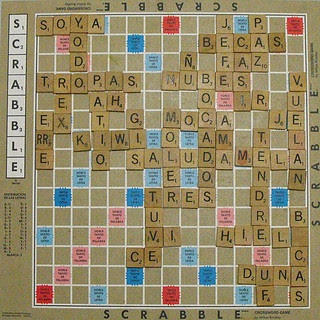
Play games with Spanish


Scrabble® is the best game for acquiring Spanish vocabulary stress-free
Photo credit: hdaniel licensed CC BY-SA 2.0
Most of us spent a major portion of our formative years playing Scrabble®, Hangman®, Monopoly®, and countless other board games. These games were more than just recreation and entertainment. They shaped up our childhood. They were the subtle hands behind our improved skills, like logical reasoning, mathematical aptitude, and most importantly, vocabulary.

Yes, the impact of games like Scrabble® and Hangman® on vocabulary acquisition can hardly be denied. Imagine the results if you start playing these games in Spanish and constantly strive for perfection. And strive you will because that’s the very virtue of games; they are built to kick your butts until winning becomes your habit. They did wonders to my Spanish vocabulary and, I am sure, won’t disappoint you either.

If multimedia games are your poison, almost every conceivable title today, leastwise the most well-known, major labels, comes with a Spanish version. Build a discipline to play whatever you play, in Spanish and only Spanish. I admit playing an intensive MMRPG in an alien lingo would not do much for your odds at winning in the beginning, but a few losses are honestly no big deal if you are learning Spanish. Given enough time (and it won’t be too long), you will come to grow more confident and the Spanish instructions of your favorite game would become second nature to you.

Personally, I would still prefer the traditional technology-proof route. There cannot be a cheaper alternative to Spanish board games, when it comes to stress-free recreational learning within one’s home. It doesn’t matter even if you need to cheat and use the dictionary in the beginning. no matter how you play, it’s impossible not to absorb at least a fraction of Spanish that hits you during the course of each game. Even if you acquire just one word after playing Scrabble® using the dictionary for a whole hour, treat yourself. No learning is small learning. Rome wasn’t built in a day.

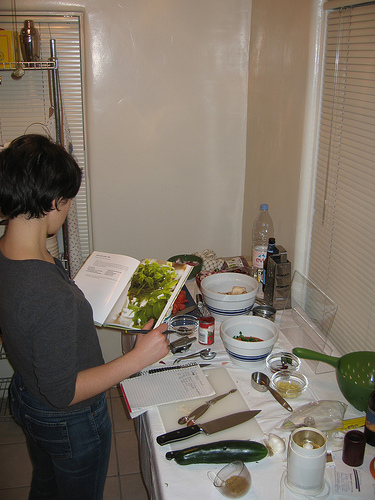
Build Spanish in your kitchen – meal by meal


Why spare your kitchen?
Photo credit: Sam Felder licensed CC BY-SA 2.0
If you enjoy cooking as much as I do (just kidding; I hate cooking), you are probably spending at least no less than an hour in the kitchen everyday. Why not include this wonderful space in your otherwise partially immersed environment? There’s a lot of room for Spanish in this space, trust me. To start with, try labeling all cans, containers, and bottles in Spanish. So, you can have labeled cans containing azúcar (sugar), sal (salt), salvia (sage), etc. sitting in your larder constantly pumping you with effortless Spanish day in and day out. Wasn’t that easy?

Another excellent way to add more Spanish to your life the delicious way is to try cooking in Spanish. Just mine the Internet for some delicious recipes written completely in Spanish and cook off them. This might be a bit exasperating at first but over time, you’ll notice that most words repeat over and over again and hence stick to your memory without any effort. These would be the words for most cooking-related activities like broiling, boiling, heating, chopping, and so on. Just be careful with the recipes at least in the beginning so as not to misinterpret or overlook anything or else you might end up with something horribly inedible on your plate!

One recreational and the other delicious, these immersion ideas are sure to give the laziest of you enough Spanish in your life to keep you motivated until you acquire perfect fluency. Let me know if your experience has been anything but uninspiring.
Read More
Posted in Immersion | No comments

Che Beyond Guevara

Posted on 04:07 by the khali
For most of us lesser mortals who don’t have Spanish in our blood, the word, che, stands for Ernesto Guevara of Argentina and little else. However, now that we are learning Spanish with dreams of becoming one of them someday, it is interesting as well as essential to know that che is to the Argentineans what güey is to the Mexicans, a word with no particular meaning yet ubiquitous all over the country, more so than probably any other vernacular expression. If you are in Buenos Aires, you’d hear this word spoken almost twice every minute and this is no exaggeration of this word’s dominance over the Argentinean lifestyle.

Che is to Argentina what Güey is to Mexico
Photo credit: Adam Jones licensed CC BY-SA 2.0
This article digs into the anatomy of the expression that has, over the decades, come to define the Argentinean identity. In fact, the English equivalents, like buddy or dude, don’t even remotely define your nationality or heritage in the same way as che does.

So what does it really mean?


This word could be used in any one of the three senses depending on the context; though largely interrelated, they have subtle differences in meanings only native Argentinean ears can catch out of nature. These three uses are:
  1. As the local Spanish equivalent of “hey” in English (like when you’d call the bartender’s attention for more Quilmes), 
  2. As the local Spanish equivalent of “buddy” or “dude” in English (like when you have
  3. As a meaningless interjection, a conversation filler (like “er” or “you know” in English or este in Mexican Spanish)
So, we can see che is more than Che Guevara. In fact, Ernesto Guevara himself got this nickname because of his habit of saying this word all the time, just like any Argentinian. Let’s delve a bit deeper into each of the 3 scenarios listed above. Depending on the context, it loosely corresponds to the English expressions like “mate”, “buddy”, “man”, etc. It can also play the role of an interjection not different in usage from the English word, “hey”, when calling someone’s attention; for example, “Che Javi, ¡ven aquí!” (Hey Javi, come here!).

As said above, che can also be employed as an informal conversation filler to assert comprehension, interest, or agreement. In this sense, common equivalents in English would be “well”, “so”, “right”, or even “er”.

The Guevara angle


Ernesto “Che” Guevara de la Serna
Photo credit: Leonora Enking licensed CC BY-SA 2.0
Che has also gained currency in other countries of Latin America that share borders with Argentina, such as Paraguay, Brazil (where it’s spelled tchê), Perú, and Bolivia. Che owes much of its popularity to Mr. Guevara who helped spread it’s usage to Cuba and to the rest of the Spanish-speaking world, and even beyond. Guevara himself earned this nickname while working with Cuban exiles in Guatemala in mid-1950s from his dialectal use of the word. To his Cuban comrades, the expression was a curious feature of his idiolect. Most Latinos know him simply as el Che as a result. Had it not been for him and his role in the Cuban Revolution, the expression would have remained confined within the borders of Argentina, a whole world outside totally unaware of its existence.

So, if you ever happen to be in Argentina and wish to sound like them, you know what the first thing to do would be. Yes, say che each time you begin or end a sentence, pause in between, or call out to someone regardless of how far they are from you. Of course, you also need to master Spanish before you start sounding even remotely like them but che must still be an integral part of your vocabulary.

Origins of che


As interesting as mysterious is the story of che’s etymology which is still not very clear. It is quite possible that this word is drawn from the many South American Indian tongues. At least four indigenous languages are know to have che in their vocabularies; in Guaraní (meaning “I” or “my”), in Mapudungun (meaning “people”), and in Tehuelche and Puelche (meaning “man” in both).

Ancient Spanish is also known to have a word, ce, that was used in a vocative sense for calling out someone’s attention. Theories range from plausible (che being the shortened version of escuche meaning “listen”) to remote (che deriving from the Italian ciao meaning “bye” or cioe meaning “that is”).

Outside of Argentina


Now, time for some interesting trivia. The Argentine word, che has a distant European cousin that goes as xe and is widely used in Valencia as an expression of exasperation, surprise, or protest. The link between Valencia and xe is so strong that the Valencia CF is popularly referred to as the “Xe Team”! Xe also exists in the streets of Terres de l’Ebre in Catalonia.

Coming back to our good old che, it is also used in the Philipines, a former Spanish colony, with a slightly different connotation. Here, che is used when interrupting or dismissing a speaker, almost similar to “shut up” in English.

And for our friends in the Balkans, che is not different from re, which is a similar interjection in your part of the world with identical usage.
Read More
Posted in Street Spanish | No comments
Newer Posts Older Posts Home
Subscribe to: Posts (Atom)

Popular Posts

  • Does Messi Speak The Spanish Of The Illiterate?
    Most textbooks claiming to teach easy Spanish would have you believe that the letters “y” and “ll” are pronounced the same in this language...
  • 111 Spanish Slangs From The Streets Of Peru
    The Spanish language takes a whole new dimension in the pueblos of Peru where the indigenous tongues, such as Quechua, have had a profound ...
  • Some Costa Rican Words For Your Private Organs
    Regardless of who you are and how you are learning Spanish, one of the first things that strike you as irresistibly interesting is the glos...
  • Fresas And Nacos: The Preppies And The White-Trash Of Mexico
    No linguistic study of any human culture can ever be complete without a fair understanding of that culture’s social stereotypes. Yankees, re...
  • Mexican Spanish – Órale, Híjole, And Others
    It’s almost impossible to spend some time in Mexico and yet never get to hear some of those exceptionally Mexican words that typically end ...
  • 23 Local Names For “Bus” In Spanish
    From Bogotá to Barcelona and from Guadalajara to Granada, the streets of the Spanish-speaking world are a familiar sight and buses must, un...
  • 3 Meanings Of Acelerado
    Just like in English, words in Spanish can, and often do, take a figurative meaning that is entirely different from what it literally means...
  • Jacket Vs. Hand-Job!
    Like all other tongues, the Spanish language too has its own share of regional quirkiness and the one from Mexico, in particular, is no di...
  • Of Pinky Swears And Middle Fingers
    Here’s a classic example of what classrooms and grammar books do to your Spanish. One cannot doubt you must have learned and mugged up the ...
  • Taking A Bath Or Taking A Shower?
    Two words one picks up pretty early in their Spanish-learning program are ducharse and bañarse . If you are one of them, you already know ...

Categories

  • Deconstruction
  • General
  • Immersion
  • Movies and Shows
  • Music
  • Resources
  • Street Spanish
  • Tips and Tricks
  • Vocabulary

Blog Archive

  • ▼  2014 (1)
    • ▼  February (1)
      • 6 Ways To Turn Your Vacation Into A Spanish Learni...
  • ►  2013 (23)
    • ►  July (3)
    • ►  May (3)
    • ►  April (6)
    • ►  March (4)
    • ►  February (7)
  • ►  2012 (70)
    • ►  December (9)
    • ►  November (19)
    • ►  October (31)
    • ►  September (11)
Powered by Blogger.

About Me

the khali
View my complete profile