anthemtour blog

  • Subscribe to our RSS feed.
  • Twitter
  • StumbleUpon
  • Reddit
  • Facebook
  • Digg

Thursday, 1 November 2012

Love, Sex, And Lots Of Spanish!

Posted on 20:26 by the khali
If you have a weakness for everything Mexican, including Mexican Spanish, few films will teach, exhilarate, and inspire you more than this one. We dig road-trip flicks which is why Diarios de Motocicleta (The Motorcycle Diaries) is amongst our top recommendations to anyone learning Mexican Spanish or researching the Latin American culture. This is also partially why Y Tu Mamá También (And Your Mother Too) gets an article of its own here. Most importantly, the movie is a rich source of the local slang lingo and colloquialisms of Spanish as spoken in the country that has more Spanish speakers than any other in the world.

Gael García Bernal: One of the finest stars of Mexican cinema
Photo credit: Yann Caradec licensed CC BY-SA 2.0

The movie that made Gael


Well, to be very honest, though the movie released way back in 2001, it wasn’t until 2009 that I finally watched it for myself. All those years, however, I did know this movie in bits and pieces from an assortment of sources; for example, I knew that it was about a trio on a crazy road-trip across Mexico, that it was critically acclaimed all over America, that it had a generous dose of sexual content, and that it literally launched Gael García Bernal on the Mexican movie scene. What I failed to recognize back then was how this movie could prove incredibly indispensible to anyone learning Spanish, particularly the Mexican flavor!

I admit I just loved Gael García’s acting skills in this film but I was already a fan way before I watched it. More than half a dozen awards for his work in this film meant he would become the instant hot-property in Mexico everybody was after. Starting here, Gael went on to play his signature roles as Che in not one but two epic masterpieces including Diarios de Motocicleta! It only helps to note that he comes from Guadalajara which is widely accepted as the epicenter of Mexican culture and that he started acting before he started going to school.

The essence


Though, like I said, the film doles out generous helpings of skin and erotica, it is not sex that stands out in the story; what stands out is the artistic presentation of all this sleaze. And, yes, there’s more than a hint of homophobia with Gael García Bernal and Diego Luna sharing quite a chemistry. Nevertheless, the story is more about the teenagers’ coming of age, their friendship, and the changing chemistry between them during a summer road-trip they made with an older chick escaping from her marriage.

The trip in itself, a remote hint of Diarios de Motocicleta, is all about flamboyance, youthful hedonism, adventure, and a sense of liberation. The icing on the cake is their diverse social backgrounds which helps paint one of the most authentic pictures of modern Mexico’s class differences. Julio, played by Gael, from a middle-class family subscribing to leftist ideologies while his friend, Tenoch, played by Diego Luna, comes from a high-profile political family. It should only be a given that, if you are keen on knowing the Mexican culture and lifestyle while learning Spanish, this movie is probably the second best means of the closest possible encounter, the best being living in the country for a first-hand experience.

A goldmine of Mexican colloquialism


One reason why this movie deserves a spot in every Spanish learner’s collection is its heavy reliance on dialogs. Dialogs are key to understanding this story as what matters most here is what the characters say rather than what they do.

Also, since you are learning Spanish, especially the one spoken in Mexico, you don’t want to miss out on the goldmine of local colloquialism and slang jargon that these dialogs offer! For this reason, it is infinitely important that you watch this movie only with subtitles – Spanish, of course. As far as the visuals go you are in for a treat, for the camera rolls past some of the most breathtakingly original images as the protagonists drive past the poor Mexican countryside.

Were this movie produced by a glamorous Hollywood house, it would have been your typical raunchy road-trip skin-flick with little more than cheesy lines and naked people all over each other like a bunch of hampsters. But we are talking about Y Tu Mamá También here, which is as deep as it gets with its layered characterization, refreshing visuals, engaging dialogs, and a rare, raw storyline.

Our strong recommendation: Whatever you do, just do not skip this masterpiece no matter what if you are truly crazy about learning Spanish. Just don’t forget to hook it up with original Spanish subtitles and you are done. And don’t let yourself be put off by the sex and homophobia because even if the message of this film is out-of-sync with your philosophy, remember that your goal is learning Spanish and this movie fits the bill in every way imaginable.

Don’t forget to watch it over and over again in infinite loops until you are capable of recalling the lines ahead of the characters and can understand every single word without the subtitles. That will certainly take time but, as they always say, the juice is by all means worth the squeeze!
Read More
Posted in Movies and Shows | No comments

Wednesday, 31 October 2012

Stay Silent And Get Fluent...Quickly!

Posted on 13:02 by the khali
Immersion seems so natural and yet there hardly seems to be any Spanish-learning methodology more controversial than this! Why exactly? Well, apparently there doesn’t exist a definitive answer yet but it can be vehemently affirmed that there exist more plausible evidences proving its benefits than the contrary. Actually, even the academic purists vouch for total immersion. Where, then, do we disagree? That bone of contention is called “grammar”. While academics consider it the be-all of any Spanish language acquisition program, successful polyglots unanimously counter it with what they call “silent, no-frills input”.

Ever since we started learning a language that was not our own (English for most of us), we have been wired with the idea that grammar is the start and end of learning a language. Let us shock you now with an assertion: This is precisely the opposite of what really is. Yes, it is possible to get fluent in any human language, let alone Spanish, while never turning a single page of that grammar book! To shock you even further, learning a language without touching grammar is a more efficient and quicker way and the only natural way of doing it. And we are not even the first ones laying this claim. This assertion is backed by rock-solid linguistic research and results experienced by established polyglots all over the world learning all kinds of language.

An example from my life


So, back to learning Spanish. Where do we start if not with grammar? The most efficient idea, which we will be harping on shamelessly throughout our conversation, is to doggedly focus on absorbing the language to the point of saturation to begin with. Note that this article prefer using the word, “absorbing” instead of “learning” when it comes to Spanish, or any language for that matter. There’s a massive difference.

Learning is what I did with Sanskrit when I was in high school. Did I like Sanskrit? Hell, no! But I had to learn out of compulsion. And I did! Crammed up every single word in the ugly little textbook and all the complex case-tables mandated by the Sanskrit grammar and actually scored good grades on my tests. In fact, when it came to tests, I fared better in Sanskrit than in English or even my mother tongue, Hindi! But, was it any useful? No. I was never able to have a 30-second elevator chat with someone in Sanskrit while I could rattle off in English or Hindi for hours at a stretch.

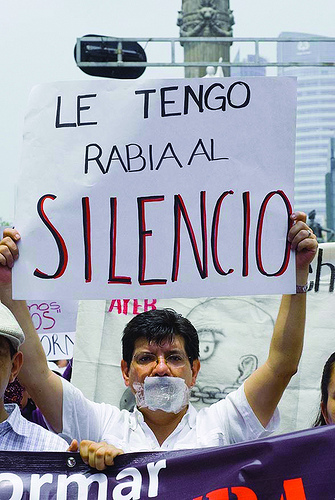
The silent-period is a wonder-drug for fluent Spanish!
Photo credit: Knight Foundation licensed CC BY-SA 2.0
So where does this leave us? What I did with Sanskrit here is called learning, while I had simply absorbed English and Hindi. What I am trying to establish here is that learning a language is reading and memorizing words and grammar rules for a purpose. A short-term goal, e.g., a test. This can get you good grades on a test but will never make you practical in that tongue. If you wish to get fluent in any language and be able to converse with native speakers with ease, what you need is absorption. Soak up the language. Listen to it and let it roil inside you. Saturate yourself with the input to a point of absolute comfort. That’s when you should consider practicing the language and referring to its grammar.

Silent-period


We all know and have been told countless times that absorption is how we acquired our mother tongue and hence it is the most natural methodology. Putting it in practice for a second language like Spanish, however, gets more radical. The idea is to not attempt to speak a word of Spanish nor read any grammar for a pretty long time. Some call this the “silent period”. During this silent period, all efforts must be invested in listening. Listen to Spanish. Authentic Spanish. As much as possible. Watch telenovelas, listen to podcasts, listen to Spanish music, watch Spanish movies...just listen incessantly. Only when the time is right, should you consider producing some Spanish.

Break your silence when the time is right


The obvious next question would be, when? Well, when the time is right, you just know it. Think of it as an extremely annoying and ubiquitous TV commercial. Your guts hate that commercial and the moment it comes on TV, you curse under your breath. But just because it’s being shown over and over again, day in and day out, did you notice something? It started growing on you! Ever found yourself subconsciously humming the jingle in your shower or while you are cooking? That’s the power of your subconscious. You absorbed that commercial. The words, the sentence structures, the patterns, the intonation, everything. And, only when you are saturated, does it become your second nature to reproduce the sounds you absorbed and you start humming them unknowingly.

It’s the same with Spanish. When you are too loaded, you will start producing automatically. Not only will you start speaking spontaneously, but you’ll also start developing an ear for what word combination or pattern sounds right and what just doesn’t. All this when you haven’t started studying the rules governing the sentence structures in Spanish! In other words, you will recognize the very signature of Spanish and this is all it takes for you to be eventually fluent like the natives. Call it overkill if you will, but if it worked for me, I am sure it will for you too.

And when is that?


So again, when is the right time? Some say it’s 10,000 hours while some say it’s 800. The numbers would largely depend on your individual knack and environment and our advice would be to steer clear of any number written-in-stone. There’s no magic count at which you’ll suddenly start rattling in Spanish like a native speaker. This is, instead, a very personal and subjective concept. As a thumb-rule, we would still recommend no less than 500 hours of silent period before you even think of taking the plunge.

Again, what is immensely important is that these 500 hours must be evenly spaced out and must be consistent over a period of time. What is meant is that if you spend 8 hours watching telenovelas on the first day and then only 30 minutes the next day and skip it completely on the third day, don’t expect any miracles. It’s better, instead, to spend an equal amount of time, even it it’s as little as only 2 hours, every day without any compromise whatsoever until you hit the 500-hour mark (or 800 or 1,000).

Oh, and before we forget grammar, do use it. But only as a reference to understand anything that confuses you, not as a homework. Our suggestion, start using grammar only after you are comfortable conversant in Spanish, only in order to polish and buff-up your language skills. Isn’t this what you did to your native lingo anyways? You were already fluent in your mother tongue way before you were taught the first grammar rule for that language. Remember the same for Spanish and you should be able to fool the natives with your accent in no time.
Read More
Posted in Immersion, Tips and Tricks | No comments

Tuesday, 30 October 2012

22 Things A Smart-Ass Would Do Learning Spanish

Posted on 09:06 by the khali
We as humans love lists. Whether it’s with learning Spanish or with anything else, lists make our exercises seem more doable and within reach than they actually are. So, when it comes to learning a foreign language where we could use any help available to make it easier, such a list won’t be a bad idea! Taking this philosophy ahead, this article summarizes some of the most important advises for the convenience of those learning Spanish in a numbered list. Needless to say, it is strongly recommended that you keep a hard copy of this list handy for reasonably regular reference. Won’t hurt to put it up on that refrigerator.

The 22 important tasks for easy Spanish

If you are serious about Spanish, be obsessed with it
You’d better be obsessed with Spanish
Photo credit: gthills licensed CC BY-SA 2.0
  1. During the initial phase of your Spanish-learning program, just try to listen to Spanish as much as possible. This is essential for you if you wish to develop an ear for Spanish. Listen to radio broadcasts and podcasts in Spanish and there are many available for free just for you!

  2. Develop a deeply-rooted desire, a compulsion, or even better, an obsession to learn Spanish. Without an obsession, you are not likely to get too far. Lack of a compulsive desire to master the language is, by far, the biggest reason behind people quitting their Spanish programs half-way through.

  3. Maximize the utilization of time otherwise wasted, in learning Spanish. Every time you find yourself waiting at the doctor’s office, standing in that line, waiting for the elevator, or lying sleepless in bed, treat that free time as a window of opportunity that mustn’t be wasted.

  4. Never learn individual words off a dictionary. Always think and read in context. Learn phrases instead of words. It’s always easier, more practical, and more thorough to learn the Spanish for, say, “I am going to the bank”, instead of the Spanish for each words individually. This helps you absorb subtle grammar too.

  5. Visualize. Use your imagination as far as practically possible. Human brain retains wholesome imageries better than written words and sentences. Lifeless vocabulary and dead-beat grammar, when augmented with pictures and sounds tend to come alive and stay in your active memory for longer.

  6. Create stories and write them out in Spanish as much as possible. Use native language for words whose Spanish is still unknown and look them up later. Then write the same story again. Repeat this until perfection.

  7. Watch videos and original programming in Spanish. Youtube® is a massive reservoir of free resources of this kind and there are many more available on the Internet. LoMasTV® is another promising resource solely aimed at people who are learning Spanish.

  8. Use flashcards, physical or virtual (e.g., Anki®) depending on your preferences, to review and consolidate newly acquired vocabulary. Again, use phrases or sentences instead of words for reasons stated earlier.

  9. Use exotic mnemonics or other visual aids to learn and retain new Spanish vocabulary or concepts. The sillier your mnemonic, the better for retention. The more it stands out, the better it stays in!

  10. Browse through a Spanish-English-Spanish dictionary as often as possible. Do not make a deliberate attempt to memorize words off the dictionary. Just browse and let interesting phrases drive home naturally. Pay more attention to the example phrases than the words themselves.

  11. Draw two columns in a notebook and list out phrases, those in your native language on the right and the Spanish equivalent on the left. This is another memory aid that functions in a fashion not much different from flashcards.

  12. Pick an extremely primitive kids’ story book (fairy tales or fables), and try translating it into Spanish. Be creative and use your imagination to improvise on the original plot. Make it as funny and silly as possible utilizing your knowledge of Spanish and a limited vocabulary.

  13. This one is interesting and we are not sure of the rationale behind this tip in learning Spanish but they say it works anyway: Learn the past tense before learning the present and the latter before the future tense. Maybe because that’s the natural order of events? One seriously wouldn’t know but it surely looks like a harmless experiment nonetheless.

  14. Pick unfamiliar Spanish sounds and practice them while driving or taking a shower, or whenever you find yourself alone doing something mundane. An example could be the notorious “rr” sound of Spanish!

  15. Use free online resources for not only learning Spanish but also learning interesting things about the culture of places where Spanish is spoken. Develop an affinity for the Latino lifestyle and culture.

  16. You must have read several books and stories in your native language before. Now, try reading them in Spanish. Use a dictionary if you need but don’t revert to your native language, come whatever may.

  17. Read comics and graphic novels in Spanish.

  18. Try thinking in Spanish instead of first thinking in English and then translating your thoughts into Spanish before speaking.

  19. Read Spanish grammar. Yes, it is true that we always encourage you to stay away from memorizing those regimented rules of grammar like the plague but reading them is another story altogether. Just browse through that Spanish grammar tome without dwelling on any rule or memorizing it. Whatever is relevent or important will automatically stick to ur brain. Don’t do anything more than just frequently scanning the book.

  20. Label most household items with their names in Spanish.

The 2 “most important” tasks for easy Spanish!

  1. Make mistakes without regret or remorse.

  2. Take a very short break every once in a while just to cool it off and to allow all that Spanish to sink in.
Read More
Posted in Tips and Tricks | No comments

Sunday, 28 October 2012

Jacket Vs. Hand-Job!

Posted on 11:38 by the khali
Like all other tongues, the Spanish language too has its own share of regional quirkiness and the one from Mexico, in particular, is no different. In fact, it is this quirkiness of Mexican Spanish that makes it one of most learners’ top favorites amongst all known dialects of Spanish. Let’s explore this quirkiness in something as simple as a “jacket.” We all know it translates to la chaqueta in Spanish. What makes it so special here is that this seemingly innocent word for a piece of clothing has an embarrassing, far-from-innocent, kind of perverted connotation in the streets of Mexico and you must be careful when using it!

The Spanish for “jacket”


Do not call this a chaqueta in Mexico!
Photo credit: Marshall Astor licensed CC BY-SA 2.0
Though Spanish has an extremely diverse vocabulary, enriched by the myriad indigenous cultures it has touched over centuries, we are going to be more concerned about the two most commonly used words for the humble “jacket” in the Spanish-speaking world – chamarra and chaqueta. Of these, chaqueta is the one that carries a sort of stigma at least in Mexico and should be avoided as far as possible if you happen to be in that part of the world. What’s wrong in calling a “jacket”, chaqueta?

Well, before that, let’s first get to know the word that Mexicans use for their jackets – chamarra. Now, chamarra means nothing other than a “jacket” and is hence understood in any Spanish-speaking country even though it is not common outside of Mexico. Same way, it’s not that the Mexicans don’t recognize the dictionary meaning of chaqueta which is commonly used everywhere outside of Mexico for “jacket.” Mexicans understand that chaqueta means jacket no less than their counterparts elsewhere but they choose to accept the other, more colloquial meaning that’s nothing short of taboo.

If you haven’t heard of chamarra yet, tarde o temprano (sooner or later) you will. What you should hope, though, is that you bear it well before you ever enter Mexico. If you need a jacket in Mexico, you say, “Hace frío por eso necesito una chamarra (It’s cold so I need a jacket),” and all’s well. By any chance, if you happen to use chaqueta in that sentence, nothing will say, “I am a stupid gringo,” clearer and louder! All of Mexico would unite in giving you the blush of your life before you even realize what you just said. Your problem intensifies as you move further south. In fact, most gringo-infested regions of northern Mexico do recognize chaqueta and honor its usage without much` fuss. but for the rest of the country, it’s just plain taboo. In fact, even Bolivians also prefer to avoid using this word for the same reason.

The chaqueta taboo


So, what the heck does chaqueta mean in Mexico anyway? And what makes it an embarrassment to the unsuspecting gringo? Well, for the lack of a more politically-correct word, it means “masturbation”. Blush, blush! Well, for whatever reason, the word has become integral to Mexico’s jargon of crude lingo and is applicable to both men and women. The act of self-gratification itself is better portrayed by the phrase, hacerse una chaqueta. Now, you can imagine the reaction of your Mexican buddies when you ask for a chaqueta because it’s so cold!

No, you will not be shot dead or deported if you do wind up using this word anyway. Like already mentioned above, chaqueta is well understood as the Spanish for “jacket” even in Mexico, more so in the north. It’s just that because it has a dirtier meaning, they would prefer to hang on to the latter and make the most of the situation at your expense, laughing their hearts out. It is our two cents, though, to steer clear of chaqueta in Mexico and stick to chamarra instead, unless some sort of pun is intended. On the other hand, innocent mistake could make you sound kinky to Mexican ears and possibly win you some amigos (friends) or even dates, who knows! The choice is yours.

More Spanish for more jackets


The Spanish for a suit-jacket, by the way, is saco and is so on both sides of the Atlantic. Also, Spain has cazadoras that refers to more informal types of jackets, such as denims or bombers. In the name of variety, chumpa is another word for “jacket” used in El Salvador, Guatemala, and Honduras while in Ecuador, they have chompa. And Peruvians and Chileans use casaca! Wait, there is more! If you ever visit Argentina, Uruguay, or Paraguay, you’ll hear them call it campera. And as far as chamarra goes, it’s not just the Mexicans. Chamarra is also known and prevalent in Bolivia and as far away as Andalusia of southern Spain. Even more interestingly, in Costa Rica, Cuba, and Puerto Rico, they just use the English word with a Spanish pronunciation (they pronounce it /yah-'ket/).

So, before concluding this article, let’s summarize the idea: Spanish has two words for a jacket, la chamarra and la chaqueta. while both words are well known in all of Hispanosphere, the former is the only one used in Mexico and the latter, elsewhere. Moreover, la chaqueta has a very vulgar meaning in Mexico and is better not used when talking about the item of clothing.
Read More
Posted in Street Spanish | No comments

Taking A Bath Or Taking A Shower?

Posted on 10:05 by the khali
Two words one picks up pretty early in their Spanish-learning program are ducharse and bañarse. If you are one of them, you already know what grammar has to say about their meanings – that ducharse means “to shower” and bañarse means “to bathe”. Simple, isn’t it? Unfortunately, you are in for a little bit of disappointment if you spent countless hours cramming up these meanings off the dictionary. Why? Well, because the streets of Latin America have a slightly different way of talking about bathing. This is another of the several classic examples of how the Spanish language has evolved differently in different cultures.

Mexicans don’t duchar


ducharse
Me voy a bañar en la ducha
Photo credit: Suedehead licensed CC BY-SA 2.0
As mandated by the dictionaries, both these verbs are reflexive which means in Spanish, you don’t bathe; instead, you “bathe yourself”. Same goes for shower. So, voy a ducharme/bañarme is “I am going to take shower/bath,” and so is me voy a duchar/bañar.

Now back to Mexico. Here, people use bañarse for the action regardless of whether it’s performed under a shower or in a hot-tub! So, me voy a bañar or voy a bañarme would mean both “I am going to take bath”, as well as “I’m going to take shower”. No need to use ducharse at all! So, now we know better that while in Mexico, you just use bañarse at all times. Also, it is worth mentioning here that you won’t go completely misunderstood if you do end up using ducharse in Mexico albeit it will surely give away your non-Mexican background.

So how do you tell the difference?


That pretty much simplifies everything. One word for both taking shower and taking bath means one fewer word to cram. But if you are like me, you will ask the million-dollar question: How to tell if one is actually taking shower under, well, a shower and not soaking in the bath? Turns out, there’s a simple, three-word solution, en la tina. This phrase when added to the verb, bañar, becomes bañarse en la tina and lends the effect of “bathing in the bath” to the sentence. So, if you want to say that you are going to bath specifically as against taking a shower, you’d simply say, voy a bañarme en la tina or me voy a bañar en la tina or me voy a tomar un baño de tina. The latter literally translates into “taking a bath in the bathtub”.

bañarse
Me voy a bañar en la tina
Photo credit: Liza licensed CC BY-SA 2.0
Similarly, bañarse en la ducha can be used to mean “taking shower under the shower.” No points for guessing that the verb, duchar (to shower) actually comes from the noun, ducha which means, you guessed it right, “shower.” Agreed, bañarse is much more simpler than bañarse en la tina and ducharse is much simpler than bañarse en la ducha but we all know Mexicans have their own crazy style of doing things.

So, by now you must have understood that la tina refers to “the bathtub” (also called la bañera) and la ducha, “the shower.” Again, only if life were that simple! You will often hear Mexicans using multiple words for everything including their bathtub which could also be referred to as la bañera or even la bañadera. Don’t worry, however, you will not be crucified if you do end up using ducharse for “taking a shower” as it is standard Spanish and educated speakers round the world understand standard Spanish quite well. You won’t sound, er, Mexican though. Please note that this usage of bañarse for both bathing and taking shower could also exist in some other parts of Latin America, especially places that experience degrees of Mexican influence. In Spain, however, ducharse is the norm for what it means.

Further trivia


At this stage, it is important to add that while ducharse is alien to Mexican ears, it is also unheard of in many other Latin American countries, the Southern Cone in particular, i.e., Argentina, Peru, Chile, etc. On the other hand, in Spain, bañarse is used for bathing in any water body and not just a bathtub. So, you use bañarse when bathing in a river, beach, or even pool. Darse un regaderazo is what they say in El Salvador when talking about taking a shower. However, the same phrase would take on an entirely different meaning if you were in the Southern Cone. For example, in countries like Chile and Argentina, you would use the phrase when you talk about watering the plants.

Remember that, depending on the community you find yourself in, you could be either taking a bath (tomar un baño) or giving yourself a bath (darse un baño). Of course, the phrases become tomar una ducha and darse una ducha when an actual shower is being referred to. This is yet another variety that you could encounter if traveling to a Spanish-speaking country.

If these tidbits of street Spanish intrigue you and rake up your curiosity, feel happy for this is an indication that your mind is actively absorbing Spanish on its own without any use of force on your part! Learning Spanish can never be an act of reluctant force. You have to savor its rhythm, its diversity, its sound, and its rich vocabulary in order to ensure maximum absorption and minimum efforts.
Read More
Posted in Street Spanish | No comments

Of Pinky Swears And Middle Fingers

Posted on 08:02 by the khali
Here’s a classic example of what classrooms and grammar books do to your Spanish. One cannot doubt you must have learned and mugged up the Spanish names for the parts of your body right within the first few weeks of your Spanish learning program. So you know that mano means “hand” and dedos de la mano or deditos means “fingers”. What you don’t know and would have never been taught, however, is the names of each of those deditos in Spanish! It is these practical nuggets of interesting and useful trivia that classroom curriculums often sidestep, thereby giving you a Spanish that is both impractical and often deficient.

Names of the fingers


First off, there’s your thumb. This one is called dedo pulgar, or simply pulgar, in Spanish. Now, since Spanish doesn’t distinguish between fingers and toes, the word, pulgar, could stand for both thumb and the big toe. In cases of ambiguity, one could use pulgar de pie for the big toe and pulgar de mano for the thumb. In Spain, it is quite usual to refer to the big toe as dedo gordo del pie.

The one next to it is the índice (index finger or forefinger). Obviously, it derives from the same Latin source (index) that gave us the English term. Some dictionaries also call it dedo índice but you should do well with just índice in the real world.

The notorious middle finger, too, has a name of its own in Spanish. They call it dedo corazón, dedo medio, mayor, or simply, medio. I have no answers if you asked why it’s called dedo corazón (heart finger); maybe because it sits in the heart of the fingers when placed in order? Other two names, dedo mayor (large finger) and dedo medio (middle finger) are pretty self-explanatory.

Regardless of whether you are a gringo or a chilango, you always wear your ring on your dedo anular or just anular (ring finger). Incidentally, the ring itself is called anillo in Spanish and both anillo and anular derive from the Latin, ānulāris, which means “ring-shaped”. Remember what they taught you in school about an annular eclipse where the Sun looks like a ring? Guess you get the connection now.

Finally, that little pinky is called dedillo, dedo pequeño,  dedo meñique, or just meñique. One can also add del pie to dedo pequeño and refer to the corresponding toe as dedo pequeño del pie.

So there you are, five fingers each with a name in Spanish at your fingertips!

Doing things with your fingers in Spanish


Learning Spanish: Fingers crossed!
Photo credit: John Nakamura Remy licensed CC BY-SA 2.0
Let’s now see what interesting things can be done with those fingers in Spanish. Naturally, this list would just be a part of a much bigger one and I would love to hear from you if there’s anything I don’t know and you find interesting!

promesa de meñique – This is “pinky swear” in Spanish. Not sure if you’re ever going to need this one but it helps to know that promesa is the Spanish for “promise” (needless to say, the two words share a common origin) and, hence, promesa de meñique stands for a “promise by the pinky” or, in other words, a “pinky swear”.

Keep in mind though that saying this to a native speaker would make them stare at you and shoot you an excessively confused look. The idea of a pinky promise is not as significant in Hispanic cultures as it is for those speaking English. So, a typically ignorant native speaker will just try to figure what your middle finger has to do with your promise and be utterly confused.

Santa flips the bird
Photo credit: Dan Century licensed CC BY-SA 2.0
cruzar los dedos – The Spanish word, cruzar, is a verb (notice the tell-tale -ar ending) that shares a common etymology with its English counterpart, “to cross”. This means, cruzar los dedos is essentially “to cross one’s fingers”. Spanish has yet another phrase if you want to “keep your fingers crossed” and it goes, mantener los dedos cruzados. The word, mantener is a verb that means “to maintain” (in the sense of “keeping something as is”) and cruzado comes from cruzar.

sacar el dedo – Also known as pintar el dedo, this is the most widely recognized gesture throughout the world no matter what language you speak. Regardless of what culture you come from, you are most likely to know how to “show a middle finger” and regardless of what language you speak, this gesture always means the same thing!

If you are in Colombia, hacer pistola a alguien (to give someone the finger) is what the locals use for this gesture although the other two are not always unheard of.

pulgar arriba – You use your thumb to show your appreciation for something in English and you use your pulgar to do so in Spanish. Same goes for showing dislike as well. So, pulgar arriba means “thumbs up” and the opposite, you guessed it right, pulgar abajo means “thumbs down”.

It helps to know that arriba is the Spanish for “up” and abajo, for “down”.
Read More
Posted in Vocabulary | No comments

Monday, 22 October 2012

A Bird In Hand Is Good Spanish

Posted on 12:27 by the khali
Picking a simple sentence, especially an interesting proverb or saying, and performing a grammar autopsy on it is perhaps the easiest way of understanding and learning some practical Spanish grammar without feeling monotonous. The grammar and vocabulary one absorbs this way is practically more sustainable as small sentences are better assimilated than larger bodies of work such as novels. Using small, manageable phrases you assimilate key concepts and become better equipped to produce spoken Spanish without mental translation. With this understanding, today, we will attempt to learn some Spanish using an age-old adage.

Más vale pájaro en mano que ciento volando. (A bird in hand is worth a hundred flying.)

This is a widely recognized saying and perhaps exists in some form or the other in almost every major language spoken by humans. There might be some minor variations such as the one in English talking about “two birds in the bush” instead of the Spanish, “hundred birds flying,” but the essence remains the same. This universal recognition means you are far more likely to recall this sentence, almost as a catchphrase, than any other.

The nuts and bolts


Más vale pájaro en mano que ciento volando
Photo credit: Steve Ryan licensed CC BY-SA 2.0
Más: This word generally stands for “more” both in adverb as well as adjective forms. in this case it is used as an adverb, qualifying the verb following it.

vale: This is the singular third-person simple present tense form of the Spanish verb, valer, that means “to value” or “to score” in English. As you can easily notice, most “-er” verbs shed their “-r” when used with singular subjects in third person for the simple present tense. For plural subjects in third person (in simple present), they replace their terminal “-r” with an “-n”; for example, valer becomes valen.

pájaro: The Spanish for bird, this is essentially the subject in this sentence.

en: This one is simple; “in” is English and en is Spanish. That’s all there is...should be pretty easy to remember!

mano: This is the Spanish word for “hand”. Actually, mano has it’s roots in Latin from where English has borrowed quite quite a lot of it’s vocabulary as well. Evidently, the English word, “manual” draws from the same root and unsurprisingly stands for something done by hand. In this sentence, the complete subject, hence, is “bird in hand”.

que: This word (without the accent mark over “e”) usually stands for the English “that”. However, in certain contexts it can also come to mean “than” (in the sense of comparison), particularly when the sentence or phrase containing que also contains más (more) or menos (less).

ciento: This is how you say, “hundred” in Spanish. Remember, however, that it is ciento only as long as it is being used as a noun. If it modifies another noun, i.e., is being used as an adjective, it drops the last syllable and reduces to just cien. So, while “hundred men” is cien hombres (cien is an adjective), “hundred and ten” is ciento diez (ciento is a noun).

volando: This is the progressive or continuous form of the Spanish verb, volar (to fly). In English, we form the progressive of a verb by appending “-ing” to the base (infinitive without “to”) form. Thus, “to fly” becomes “flying” and “to eat” becomes “eating”. In Spanish, we do this by replacing “-ar” by “-ando”, and “-er” and “-ir” by “-iendo”. Hence, bailar  (to dance) becomes bailando (dancing) and vivir (to live) becomes viviendo (living) and, in this case, volar becomes volando (flying). That’s it!

String’em all together


Now, let’s put it all together. The sentence opens with más. Actually one of the ways this word is used to convey various quantity is by using it in conjunction with que. For example, in this context, the usage of más and que together indicates comparison (más...que stands for “more than” in a fashion similar to how menos...que stands for “less than”). So, más vale would just mean that something scores more or is valued more. Más vale pájaro en mano que ciento volando literally means, “A bird in hand scores more than a hundred flying,” in the following structure:

Más (with que, as a tool for comparison; here, más stands for “more”) - verb (here, singular third-person simple-present tense of “to be worth”) - subject (here, a singular “bird in hand”) - que (with más as described earlier as a tool for comparison; here, que stands for “than”) - adjective (here, a number, “hundred” quantifying the object) - object (here, “birds in flight” with “birds” being implied but not stated).

Please note that the sentence structure here shows a stark departure from the simpler S-V-O (subject-verb-object) order we are so used to. Yes, Spanish is much more flexible in it’s order than English is and the various pieces of a typical Spanish sentence can take any position depending on the context. Typically, adjectives come before the nouns they qualify (not always though) and the subject comes before the verb (with the subject being omitted and only implied if it happens to be a pronoun, e.g., I, you, we, etc.). However, often, the V-S-O order is preferred with the verb coming before the subject in contexts where the action needs a subtle stress. This is what has happened in this sentence.
Read More
Posted in Deconstruction | No comments
Newer Posts Older Posts Home
Subscribe to: Posts (Atom)

Popular Posts

  • Does Messi Speak The Spanish Of The Illiterate?
    Most textbooks claiming to teach easy Spanish would have you believe that the letters “y” and “ll” are pronounced the same in this language...
  • 111 Spanish Slangs From The Streets Of Peru
    The Spanish language takes a whole new dimension in the pueblos of Peru where the indigenous tongues, such as Quechua, have had a profound ...
  • Some Costa Rican Words For Your Private Organs
    Regardless of who you are and how you are learning Spanish, one of the first things that strike you as irresistibly interesting is the glos...
  • Fresas And Nacos: The Preppies And The White-Trash Of Mexico
    No linguistic study of any human culture can ever be complete without a fair understanding of that culture’s social stereotypes. Yankees, re...
  • Mexican Spanish – Órale, Híjole, And Others
    It’s almost impossible to spend some time in Mexico and yet never get to hear some of those exceptionally Mexican words that typically end ...
  • 23 Local Names For “Bus” In Spanish
    From Bogotá to Barcelona and from Guadalajara to Granada, the streets of the Spanish-speaking world are a familiar sight and buses must, un...
  • 3 Meanings Of Acelerado
    Just like in English, words in Spanish can, and often do, take a figurative meaning that is entirely different from what it literally means...
  • Jacket Vs. Hand-Job!
    Like all other tongues, the Spanish language too has its own share of regional quirkiness and the one from Mexico, in particular, is no di...
  • Of Pinky Swears And Middle Fingers
    Here’s a classic example of what classrooms and grammar books do to your Spanish. One cannot doubt you must have learned and mugged up the ...
  • Taking A Bath Or Taking A Shower?
    Two words one picks up pretty early in their Spanish-learning program are ducharse and bañarse . If you are one of them, you already know ...

Categories

  • Deconstruction
  • General
  • Immersion
  • Movies and Shows
  • Music
  • Resources
  • Street Spanish
  • Tips and Tricks
  • Vocabulary

Blog Archive

  • ▼  2014 (1)
    • ▼  February (1)
      • 6 Ways To Turn Your Vacation Into A Spanish Learni...
  • ►  2013 (23)
    • ►  July (3)
    • ►  May (3)
    • ►  April (6)
    • ►  March (4)
    • ►  February (7)
  • ►  2012 (70)
    • ►  December (9)
    • ►  November (19)
    • ►  October (31)
    • ►  September (11)
Powered by Blogger.

About Me

the khali
View my complete profile