anthemtour blog

  • Subscribe to our RSS feed.
  • Twitter
  • StumbleUpon
  • Reddit
  • Facebook
  • Digg

Sunday, 2 December 2012

13 Kitchen Words In Spanish In Less Than 4 Minutes

Posted on 02:08 by the khali
The Latin word, furnus became “furnace” in English and forno in Old Spanish, which later morphed into horno in modern Spanish. Armed with this little piece of history, you should find it a piece of cake to remember and recall that the Spanish for “oven” is horno! Similarly, Latin had unda (wave) which made the English verb, “undulate” also meaning “to wave”. This Latin unda later evolved into the onda of modern Spanish. No points for guessing that onda means “wave” and, by extension, microondas means “microwave”. So, horno microondas is easily your “microwave oven”! See how easy Spanish vocabulary can be with a little help?

Use etymology to your advantage


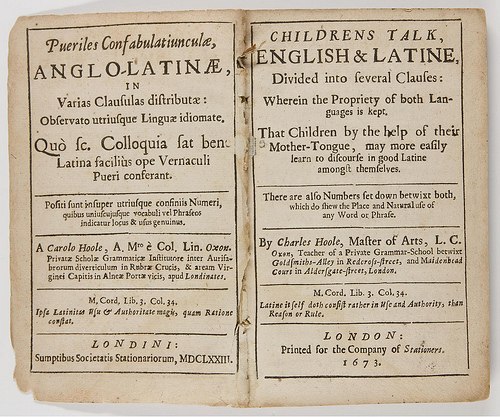
Most Spanish and English words share a common Latin origin
Photo credit: Beinecke Library licensed CC BY-SA 2.0
We have already appreciated the role visual association plays in helping us remember Spanish words effortlessly and also recall them instantly. It is, however, not always easy to come up with the most appropriate visualization for every word there is. Some words seem impossible with no apparent connection with their English counterpart. That’s where etymology steps in.

Every word has a history regardless of its language. We all know that Spanish comes from a rich family of Romance tongues all of which have a common ancestor in Latin. Similarly, English draws from a family of Germanic languages and has closer affinities with fellow Germanic lingos such as German, Dutch, Swedish, Gaelic, etc. However, English is a unique language because it also acts as a bridge between the two language families! Over the centuries, countless words from Latin have crept into the English lexicon either directly or via French, Italian, Spanish, or Portuguese.

And this is the good news for all those who are learning Spanish. Most Spanish words either bear some sort of similarity with their English meanings, or share a common ancestor in Latin. This is why, at times when no direct visual link between a Spanish word and its English counterpart seems possible, it often helps to scratch the surface and dig into its history to see if Latin could provide any missing links.

The kitchen lexicon


La cocina
La cocina
Photo credit: Rowena licensed CC BY-ND 2.0
bol (bowl) – This one should be a no-brainer as the words sound too similar to warrant any visual tool or imagination. Just understand that the difference in spelling is because of the fact that in Spanish you spelle exactly as you pronounce, more often than not.

cafetera (coffee pot / coffeemaker) – This is a classic case of what we call “false cognates” or “false friends”. Be aware that not always do similar sounding words have similar meanings in both Spanish and English. Though cafetera sounds too close to the English word, “cafeteria,” they have absolutely unrelated meanings. While “cafeteria” means a place where you sit down to eat, usually at work or school, cafetera is the Spanish for a “coffeemaker” or a “coffee pot.” The word, cafe should help you build the necessary visual linkage if required at all.

trapo (cloth/rag) – One of the easiest ways to remember this word is to imagine the dirt that gets trapped in the fine pores of that rag when you use it to wipe the kitchen surface clean.

lavaplatos (dishwasher) – Imagine a superhero who is immune to heat or fire. Why? Well, maybe because he was born in a volcano! So heat can’t hurt him no matter what and that’s why he conveniently uses red hot lava from his volcano to wash himself whenever he needs a bath. This ensures all germs and bacteria on his body are killed by the heat of the lava and he stays impeccably clean and germ-free at all times! Now this bizzare vision should help you remember that the Spanish verb, lavar means “to clean or wash” in English. Armed with this knowledge, you should find it easy to also remember that a lavaplatos is something that washes your plates or, in other words, a “dishwasher”.

nevera (refrigerator) – Before attempting this word, learn the Spanish for “snow”. The word is nieve and the simplest way to remember this is to picture the snow-capped peaks of Sierra Nevada. Now if you remember nieve, it should be no pain to understand and remember that a device that makes it is nevera in Spanish.

batidora (mixer/blender) – If you know how they use a blender to make any kind of batter, you can easily remember why the device is called batidora in Spanish.

tetera (teapot) – A tetera holds té (tea) in the same way as a nevera holds nieve (snow or frost).

cuchara (spoon) – Before you learn the visual cue for this word, have fun knowing that cuchara is a vulgar slang for a “vagina” ( more in the sense of “cunt”) in El Salvador, Guatemala, and Venezuela. Now let’s use some etymology to remember the word. the Spanish word comes from the Latin cochleare (spoon) which, in turn, derives from another Latin word, cochlea which means a “snail or its shell.” Now, imagine using a dead snail’s shell as a make-shift spoon to scrape out fruit-pulp while eating on a hiking trip across the Amazonian jungles. Sounds gross but will stick to your memory for the very same reason!

hornilla (burner) – An oven is the hottest thing you have in your kitchen and if you need something not as hot, you have a burner (either gas or oil). Since you have already learned that an “oven” is horno in Spanish, its younger cousin should easily be an hornilla. The -illo/-illa suffix has a dimunitive effect in Spanish, reducing the effect of the main word.

sartén (skillet) – Think of the utensil you use for sautéing (a low-fat cooking over relatively high heat) some delicious potatoes and bacon! Most of us use a skillet for this purpose. What about you?

fregadero (sink) – The English word “friction” carries a sense of two surfaces rubbing against each other, kind of what happens when you scrub something like a dirty utensil; now, that’s no secret. What’s little known is the fact that this word comes from the Latin verb, fricare (to rub or chafe) which also gave Spanish its fregar, carrying the same meaning. And from this verb comes fregadero the Spanish word for “sink”, a place where you scrub your dishes clean. This relationship should help commit the word to memory easily.


By the way, the Spanish for “kitchen” is cocina which comes from coquina in Latin from where English got its verb, “to cook”. Etymology to the rescue again! In fact, the same technique can be used for practically any word, including these 32 words of things you do in your kitchen.
Read More
Posted in Vocabulary | No comments

Saturday, 1 December 2012

Let Juanes Help You Learn The Spanish Subjunctive

Posted on 10:19 by the khali
All too often, the Spanish subjunctive is made to appear way more intimidating to those learning the language than it needs to. Grammar books say it is not a tense but a mood. We’d rather choose to keep things simple and for the sake of staying away from unnecessarily complicated grammatical nomenclature, will call it a form of the verb. Quite simply put, this form is used for any verb in Spanish when we are not being objective or certain about the action being performed. Today, we’ll use a wonderful Spanish language chartbuster from a world-famous Colombian musician to reinforce this concept permanently and painlessly!

What the heck is subjunctive?


The only reason subjunctive appears so alien to us learners is that English rarely uses verbs in this form while Spanish does widely. Here’s an example of subjunctive being used in English to help you grasp the idea:

I recommend that she be there when her friends arrive.

The verb, “be” in the sentence above is actually in its subjunctive avatar. In Spanish, whenever you talk of actions that are either uncertain or subjective, you bring in the subjunctive form. Here’s an illustration:

El profe quiere que aprendamos el subjunctivo. (“The professor wants us to learn the subjunctive.” / “the professor wants that we learn the subjunctive.”)

Here, since the act of learning is just a wish and not being carried out in reality at the time of speech, the Spanish verb aprender (to study) has been conjugated to its subjunctive form. There are many websites and books dedicated to helping you learn the various rules of usage when it comes to subjunctives but like we always harp, there’s no better teacher than music! Today, we will be discussing one such song that can be immensely helpful in reinforcing this piece of grammar into your head and facilitate easy recall.

Juan Esteban Aristizábal Vásquez


Juanes must figure in every Spanish learner’s music collection
Photo credit: Julio Enriquez licensed CC BY 2.0
Better known by his stage name, Juanes, this Colombian solo artist must be familiar to most of you if you have ever heard La Camisa Negra (The Black Shirt). Like many of his kind, Juanes is a child prodigy who started playing guitar when he was just seven and floated his first band (heavy metal), Ekhymosis, when fifteen. His solo debut, Fíjate Bien brought him three Latin Grammies in 2000 and the next, Un Día Normal, went on to hit platinum in several countries in Latin America. This is the lead single from this album, A Dios Le Pido (I ask God), that will help us learn Spanish today.

As of today, Juanes has to his credit a rare and impressive collection of 19 Latin Grammy Awards, one Grammy Award, 9 MTV Awards, 2 NRJ Music Awards, 9 Our Land Awards, and a string of many more awards and recognitions from all over the world! Though a major name on the Latin pop scene today, his initial act, Ekhymosis was inspired by Metallica and was entirely into heavy metal, Juanes’ favorite genre back then. This band produced five studio albums in all and collaborated with legends like Alejandro Sanz and Ricky Martin, among others.

What makes Juanes every Spanish learner’s favorite act is his love for his mother tongue. He patronizes the language with exceptional passion and is an activist for this cause close to his heart. He has vowed to never sing in English and has often been heard that he will continue to work in Spanish because it is this language in which he could express himself best. What more can a Latino-lover ask for!

A Dios Le Pido


This is the track that earned Juanes his Best Rock Song Latin Grammy for 2002. The lead single from his much celebrated studio album, Un Día Normal, charted in top 5 in almost every European country and hit #1 in twelve countries across three continents.

The song is essentially an ode to God seeking blessings and protection for the singer’s loved ones. Due to its peace invoking lyrics, the song soon became an anthem for peace throughout Latin America and garnered immense popularity.

Accolades apart and coming back to our subjunctive, this song is lyrically rich and a great source of Spanish verbs in this form which is what makes it extremely useful for us learners who are struggling to remember the subjunctive conjugations and usage. Since the entire song is essentially in the form of a wish being relayed to God and wishes are expressed using the subjunctive in Spanish, potentially every line is an illustration of this otherwise difficult-to-grasp verb-form.

As always, we am giving out a portion of the lyrics here for your review along with a rough English translation. This should give you a good jump-start. We could give you dozens of example sentences illustrating how the subjunctive is used but we are sure you do realize that you’ll retain none of them as effectively as the lyrics to a tappy, hum-worthy song by your favorite artist!

Que mis ojos se despierten (That my eyes wake up)
Con la luz de tu mirada, (With the light of your sight,)
Yo a Dios le pido. (I ask of God.)
Que mi madre no se muera (That my mother doesn’t die)
Y que mi padre me recuerde, (And that my father remembers me,)
A Dios le pido. (I ask of God.)

Que te quedes a mi lado (That you stay by my side)
Y que más nunca te me vayas mi vida, (And that you never leave me, my love,)
A Dios le pido. (I ask of God.)
Que mi alma no descanse (That my soul does not rest)
Cuando de amarte se trate mi cielo, (When it concerns loving you, my love,)
A Dios le pido. (I ask of God.)

Por los días que me quedan (For the days that for me remain)
Y las noches que aun no llegan, (And the nights that yet haven’t come,)
Yo a Dios le pido. (I ask of God.)
Por los hijos de mis hijos (For the children of my children)
Y los hijos de tus hijos, (And the children of your children,)
A Dios le pido. (I ask of God.)

There is no easier way to tame the scary subjunctive verb-form than having this song on the tip of your tongue. And there is no easier way of having this song on the tip of your tongue than listening to it over and over again until you catch yourself humming away the lyrics in your bathroom subconsciously. Go on, we promise the music won’t disappoint you either.
Read More
Posted in Music | No comments

Friday, 30 November 2012

Learn To Recount Your Imagination In Spanish

Posted on 09:56 by the khali
They say, imagination is the cheapest luxury one can afford. What few realize is that it can also be one of the most effective tool for learning Spanish. Whenever we deconstruct a sentence, we essentially break down an overwhelming behemoth of a sentence into tiny, easily understandable fragments that our minds instantly assimilate. The sentence that we are going to break down here has nothing grand about it but would prove immensely helpful if you ever try relating an account of your dreams and ambitions which in turn would build your Spanish, bit by bit. You see, imagination is also often the cheapest language teacher!

Imagine buying this Jag and write about it in Spanish!
Photo credit: Martin Pettitt licensed CC BY 2.0
If asked to let our imagination run unchecked without an agenda, most of us are most likely to imagine being capable of achieving or having already achieved what would otherwise be incredibly difficult in prevailing reality. Today’s sentence (given below along with its meaning in English which is, obviously, not very literal) should enable you to at least start giving words to such day-dreams in Spanish.

Cuando gano la lotería voy a comprarme un Jaguar y contratar a un chafirete que me lleve por todos lados. (When I win the lottery I’m going to buy myself a Jaguar and hire a driver to take me all over the place.)

The nuts and bolts


Let’s begin the dissection of this awefully long sentence:

Cuando – This is the Spanish word meaning “when” in a non-question sense. Place an accent-mark over the “a” and it becomes cuándo, a question.

gano – The Spanish verb, ganar means “to win” and when conjugated in the present indicative form for the singular first person, it turns into gano. So, this word essentially stands for “I win” (don’t forget that the subject pronoun is often omitted in Spanish and solely implied by the context). Not sure if ganar shares its etymology with the English word, “to gain” because other than sounding similar they are also quite close in their meanings. Anyways, the similarity should still be enough to help you remember the word and recall it painlessly.

la lotería – This one is a no-brainer. The English word, “lottery” becomes lotería in Spanish and the -a ending makes it a feminine noun which brings in the la.

voy a comprarme – Ir is the Spanish for “to go” and its singular first person conjugation in the present tense makes it voy. Thus, voy essentially stands for “I go” or “I am going”. The next word, Comprar is the Spanish for “to buy” and using the preposition, a (to) to link it with ir gives it the sense of someone “going to buy”. So, voy a comprar would mean “I am going to buy” just like vamos a comer would mean “we are going to eat”. So, what is the me doing attached to comprar? It is called a reflexive pronoun. Never mind the grammar; just remember that it gives comprar the sense of “buying for myself” just as comprarte would mean “to buy for yourself”. So, in short, voy a comprarme means “I am going to buy myself”.

un Jaguar – A Jag. Here we are talking about a ridiculously expensive brand of car. Dying to take one for a spin, aren’t you?

y – This is probably the simplest word of this sentence; it’s the Spanish for “and”.

contratar – The English verb, “to contract” can also be used in the sense of employing something or someone on contract or, in other words, “to hire”. Now, this verb shares its etymology with the Spanish word, contratar. This relationship should ensure you don’t forget the word easily.

a un chafirete – In Spanish, it’s a grammatical mandate to always introduce an object with an a if it happens to be a person or something personified, e.g., a pet, etc. So the word, a here introduces an object for the verb, contratar. But what, or rather who, is this object? Un chafirete is a Mexican slang for a driver. It should help to know that both chfirete of Spanish and chauffeur of French share a common origin.

que – Remember how we use the word, “that” to link clauses and ideas in English? We use que for the same purpose in Spanish though the usage is not exactly similar always. In this context, que stands for “to” in the same way it does when used after tener. So, just like tengo que ir means, “I have to go,” contratar que trabajar would mean “to hire to work.”

me lleve – So what is the verb que intends to introduce here? The Spanish verb, llevar means “to carry” in English. In this context, however, it is used in the sense of “taking someone around.” In Spanish, when you are not sure of an event’s certainty, you conjugate the verb in a slightly different fashion. The singular third person present indicative conjugation of llevar would normally be lleva. However, since we are only imagining and not sure of whether this is ever going to happen in reality, we conjugate it as lleve. Spanish grammar calls this the subjunctive form. And you must have already guessed that the word, me gives it a reflexive twist. So, me lleve would essentially mean, “he or she would carry me”; note the use of “would” in English to give it a sense of uncertainty.

por – Usually por would mean “at” or even “for” but avoid taking the meaning literally at all cost. Nothing can screw up your Spanish more. In this context, it carries the sense of “around” as in por aquí (around here).

todos lados – Lado is the Spanish for “side” but can also carry the sense of “place” depending on the context. In this context, it clearly means “place”. Todo means “all” and because lados is plural, todo becomes todos. So, todos lados stands for “all sides” or, figuratively, “all over the place”.

String’em together


Now let’s bring these pieces together. The phrase, Cuando gano la lotería means “When I win the lottery,” in the following sentence structure: Conditional word (“when”) - subject (omitted here) - verb (here, present indicative of “to win”) - object (here, “the lottery”)

The next portion, voy a comprarme un Jaguar means “I’m going to buy myself a Jaguar,” in the following order: subject (omitted here) - verb1 (here, present indicative of “to go”) - preposition (here, “to”) - verb2 (here, “to buy myself” in its infinitive, reflexive form) - object (here, “a Jaguar”)

The next piece, y contratar a un chafirete means “and hire a driver,” in the following structure: Conjunction (here, “and”) - verb (here, infinitive form of “to hire”) - object connector (here, a with no English equivalent) - object (here, “a driver”)

And the last phrase, que me lleve por todos lados means “to take me around all over the place,” in this order: Preposition (here, “to”) - object pronoun (here, “me”) - verb (here, subjunctive present indicative of “to carry”) - preposition (here, “around”) - object (here, “all sides” or “all over the place”)

Do note that unless the verb is in its raw infinitive form, any object pronoun must come before the verb (e.g., Me llamo Pedro); otherwise, it is just attached to the verb (e.g., Quiero verte).
Read More
Posted in Deconstruction | No comments

A Novel And A Movie To Teach You Mexican Spanish

Posted on 06:54 by the khali
Como agua para chocolate is a very commonly heard expression in some Spanish-speaking countries, particularly Mexico, and was the inspiration behind the title of a novel by the much-celebrated Mexican screenwriter, Laura Esquivel. Mexico is the birthplace of chocolate; in many Latin American countries (and of course, in Mexico as well) hot chocolate is a staple traditionally made by melting chocolate over a pot of boiling water and the phrase, como agua para chocolate alludes to this fact. It can be used as a metaphor for describing a state of intense feelings which could be anything from sexual arousal to maddening anger.

Como Agua Para Chocolate
Photo credit: colegiouniversitariodeperiodismo
licensed CC BY-SA 2.0

A rare success


The story’s title draws on Tita, the main character in the novel, who conveys her state of boiling fury with a statement, “Estoy como agua para chocolate.” The unusual success of this book in 1989 led to an even bigger success in the form of a movie in 1992 and when the film opened in the United States with English subtitles, it easily became one of the most popular foreign films in American history.

The film also garnered immense critical acclaim partly because it came out in the 90s when works of previously ignored minority female writers had just started attracting their due share of limelight due to the newly emerging ideas of multiculturalism in literature. As a testimony to its success, the film bagged each of the 11 Ariel Awards from the Mexican Academy of Motion Pictures and became highest grossing film to be ever released in the United States until then. There’s no denying the fact that this film is a masterpiece worth every connoisseur’s collection and the powerful storytelling transcends all language and cultural barriers.

A tragic tale of intense passion


Como Agua Para Chocolate is a very simple yet moving story of the strong family values and traditions that underscore Mexico’s cultural heritage. The story revolves around the life of Tita De La Garza, the protagonist, who is forbidden to marry because of a family tradition but is still involved with Pedro Muzquiz, her novio (boyfriend). A chain of comic events ensues after, one day, Pedro and his father visit with Tita’s family to discuss their marriage and her mom refuses and offers her elder daughter, Rosaura instead. Pedro, counting on being closer to Tita as a member of her family, accepts the liaison; this decision naturally devastates Tita who bakes her sister’s wedding cake with much crying and longing. Tita’s tears magically stir nostalgic emotions in all those who eat the cake. Later, Tita’s father dies after knowing that his wife had cheated on him some time in the past.

A year down the line, Tita prepares a meal of rose petals laced with her passion and feelings for her love in an attempt to win him back from her sister. However, instead of Pedro, it is Gertrudis who ends up having the meal and Tita’s heat and passion along with it. As an effect of the spell, she is overcome with lust while taking a shower and runs off naked in the arms of a revolutionary soldier. Rosaura is shown to have given birth to a baby boy who, for some reason, only Tita is able to nurse. Tita’s mom suspects Tita’s foulplay in this and sends Rosaura and Pedro away to San Antonio. In some time, the baby dies due to lack of Tita’s nursing and Tita becomes sick and catatonic.

At this stage, Tita is taken to Texas by one Dr. John Brown for treatment and recuperation. Eventually, Tita and Dr. Brown develop a relationship and decide to get married. Meanwhile back home, her mother is killed by the revolutionaries and Pedro and Rosaura return for the funeral. Soon after, Rosaura gives birth to a baby girl, Esperanza. Dr. Brown is called away and finally Tita and Pedro end up sleeping together.

Twenty years later, Rosaura is shown to have died of severe digestive problems and Pedro and Tita as reunited. Tragicaly, though, Pedro dies during an intense love-making session with his beloved and Tita too, burns to death along with the entire ranch. In the end, Esperanza returns to the site only to find Tita’s cookbook that told of her recipes and love for Pedro.

What’s it it for me?


For someone learning Spanish, this film offers every ingradient for immersive learning. Engaging beyond doubt, the story sucks you in regardless of which genre you like watching. It also helps to know that the film has reasonable helpings of Mexican colloquialism that will help you further your knowledge of this flavor of Spanish.

A glimpse of history also accompanies the experience and you get to see the Mexico during the Revolution. Personally I haven’t come across a better example of magical realism in any language till today. The characters in the film are set against the backdrop of the most powerful episode in Mexican history, the Mexican Revolution that ended in 1917.

The story develops at a peaceful yet interesting pace and you will find this movie relatively easier to understand even if you don’t necessarily catch every sentence being spoken. Besides, the visuals of Ciudad Acuna, Piedras Negras, and the Eagle Pass are simply priceless. The movie gets you up, close, and personal with the Mexican lifestyle in ways few storytellers do.

Maximize your benefits


As we keep harping all the time, you cannot watch a random movie once in a while and expect some miracle to bake Spanish in you. That’s not how it works. Absorbing a language takes persistence. And repititions. Yes, you must watch the movie so many times that most major dialogs, if not all, become nursery rhymes for you. You should be able to watch a scene and blurt out the line that the character is about to utter next. That is when you can claim to be saturated with all the Spanish the movie had to deliver. This might take a dozen reps or maybe even a hundred depending on your mental faculties. But saturate you will.

And no English subtitles please. You’ll kill the essence of the original lines because translations often don’t convey the original sense with the same conviction. You’ll not only miss out on the true emotions being conveyed by the original Spanish dialogs but will also delay your absorption of Spanish thus defeating the whole purpose you began with! If Mel Gibson could make Apocalypto in an extinct language and still manage success, we are sure language barrier cannot be a genuine excuse for falling back on English subtitles.

Another thing that can greatly help with novel-based movies like this one is reading the novel before the movie. You can read the novel in English if you wish but Spanish would obviously be a wiser choice. Don’t hesitate reading the book several times over before you watch the movie for the first time. This will only help further reinforce the Spanish you acquired while reading the novel.
Read More
Posted in Movies and Shows | No comments

Some Costa Rican Words For Your Private Organs

Posted on 01:14 by the khali
Regardless of who you are and how you are learning Spanish, one of the first things that strike you as irresistibly interesting is the glossary of naughty words. There are known to be countless learners, quite unsurprisingly, who have researched and assimilated the vulgar and taboo vocabulary even before they learn how to say, “¡Buenos días!” in Spanish! Even some us might as well be one of them. And this is only human; anything forbidden charms us more. Going against the grain is human nature, more so when it comes to acquiring a language. And Spanish has on offer an extremely rich glossary when it comes to vulgarism!

A word of caution


Tiquísmo is as rich as any other form of Spanish
Photo credit: Luis Tamayo licensed CC BY-SA 2.0
While we hope we don’t wind up offending anyone, you are requested to understand that what follows is extremely crude lingo and certain words, if not all, can potentially make us sound extremely unsophisticated to you. We respect your taste and advise you to skip the rest of this article if such vulgar language offends your classy taste.

If you choose to proceed, we am hoping you read it all in the sportiest of spirits and take them as an essential aspect of street Spanish which you must be able to recognize even if you choose never to use them. Also, we strongly urge you to refrain from using them in your speech no matter how well-versed you become with Spanish. Just know them and recognize them when someone is using them. And have fun!

What follows is a list of words most prevalent in common tico (Costan Rican) speech for some of the most intimate parts of the human anatomy. While all of them might not be equally offensive or even offensive at all, it is best to discuss each of these words with a Costa Rican native and understand the gravity of its meaning before deciding on whether or not you should introduce it into your conversations. Even if a word is not particularly offensive, it can still potentially make you sound funny and even wreck your image if used incorrectly.

By the way, the word, tico, is a Costa Rican slang for anything Costa Rican and tiquísmo is the word for the colloquial tico speech or dialect. This article should also serve to illustrate that Spanish is a diverse language and has more dialects than just American and Peninsular.

Penis and testicles


Banano – Literally, this word stands for “banana”, the fruit and is not particularly vulgar


Chile – This one, again, is’t too vulgar and literally stands for “chili”


Chorizo – Literally, pork sausage; hope you can see the connotation


Cojones – A crude word for “balls” or “testicles”


Garrote – Literally, this word means “club” and figuratively stands for a “big penis”


Guaba – This one is quite vulgar


Huevos – Literally this is the Spanish for “eggs” and, by extension, also come to mean “testicles” in the vulgar lingo. For the same reason, tener huevos means, “to have balls or guts or courage” not different from the way it’s spoken in English


Leche – Again, officially this word means “milk” but can also stand for “semen” if used in a naughty way


Pene – This one is probably the only sophisticated way to refer to the organ in question as prescribed by Spanish dictionaries


Picha – This is another dirty word for the organ


Pinga – This one is quite vulgar and unsophisticated


Pistol – Officially, this word means the same in both English and Spanish but the Spanish version also refers to the private organ in honor of its shooting capabilities


Pito – This word literally means “whistle” in English and is not terribly offensive


Rosca –This one’s another vulgar term used in Costa Rica


Vena –This is yet another, equally vulgar word often heard in Costa Rican speech


Verga – Again, this one is also a vulgar term from Costa Rica

Vagina


Arepa – In colombia, this is the name of a local corn pancake but in Costa Rica, it can also mean you-know-what


Bicho – This would normally mean “insect” elsewhere except in Nicaragua where it has vulgar undertones


Cachimba – Used for the private female organ in Costa Rica and Nicaragua, this word is also often used as a colloquial interjection in the sense of “fantastic” or “terrific”


Concha – Officially, this is the Spanish for a “sea shell” but most locals prefer it to mean what-can’t-be-named-here


Endija – This one a particularly offensive Costa Rican slang


Mico – This is one more vulgar term often heard in Costa Rican speech


Panocha or panocho – This is yet another dirty word


Papaya – Now, this one’s not too offensive and can be used in regular speech as a mild insult which won’t be taken seriously (of course, not in formal speech!)


Rendija – If you follow the dictionary, this one stands for a narrow slit or opening, for instance, between planks in a wall; the resemblance it bears with the female organ is the reason why it’s also often used in a much dirtier sense


Zanja – Literally, this word means “ditch” but colloquially you know what it also means

Breasts


Busto – This one sounds too similar to the English word, “bust” to mean anything but that


Pechuga – Literally, this stands for the very delicious “chicken breast” and is not a great compliment for a woman

Senos – This is the only politically correct way to refer to them

Tenís – Literally, this one’s the Spanish for “tennis” or a “tennis ball” and is exceptionally vulgar when used as the word for breasts


Teresas – This is another vulgar slang heard everywhere in Costa Rica


Tetas – This is the official, dictionary-endorsed term for “tits”


Tetuda or tetona – These are not-too-vulgar words for “big breasts”

Butt


Ano – This one sounds too similar to the English word, “anus” and hence means the same


Anillo – Literally, this is the Spanish for “ring” but in Costa Rica it means something totally different


Chanchos – Officially, this one means “pigs” but is also a tico slang for “buttocks”


Culo – This is an unsophisticated term for the organ under discussion considered as vulgar in Costa Rica as it is elsewhere


Culantro – This is a Costa Rican play on the word, cilantro (coriander)


Gluteos – This is an unoffensive word for that organ


Hueco del culo – This one is a vulgar Costa Rican slang for one’s “ass”


Nalgas – This is the dictionary-prescribed Spanish for “buttocks”


Trasero – Literally, this one stands for the “rear end”

Tener buen culículum – This expression, a typical example of tiquísmo, is a play on the word, “curriculum” or “résumé”; it essentially means, “to have a good butt,” in reference to a woman’s shapely rear.
Read More
Posted in Street Spanish | No comments

Thursday, 29 November 2012

How To Watch Spanish Movies For maximum Benefit

Posted on 04:35 by the khali
If you wish to fight, you need to practice; reading about techniques alone won’t help. Similarly, reading about easy Spanish learning techniques alone is not going to make you speak or understand natural Spanish ever. Even if you can read Spanish perfectly well, you’ll most likely have a square, cookie-cutter accent if the only input you received was the one from those studio-recorded DVDs and tapes off expensive language courses. This is where Spanish language cinema step in to the rescue. They give you an input of Spanish the way it is meant to be spoken in real, with real accent and real pace by real Spanish speakers!

How movies help


Movies give you the context necessary to absorb new vocabulary
Movies give you the context for new vocabulary
Photo credit: gregpoo licensed CC BY-SA 2.0
If the only reason you ever decide to watch a Spanish flick, do make sure that you pick a title that you enjoy – really enjoy – enough to watch even a million times even if only to make fun of the story or direction. Good or bad is irrelevant as long as it has the potential to engage you. Because you are going to watch it a zillion times so as to absorb the last drop of Spanish it has to offer. Even if you start with subtitles – which, needless to say, must be in Spanish – you must repeat the movie enough number of times to be able to watch it comfortable without any subtitles and without sacrificing on understanding any frame. Let’s see what you gain from this most entertaining form of learning Spanish:

Fluency – Spanish movies not only load with tons of new conversational idioms and phrases, but also give you the ever-important context helping you understand their essense more closely. If you have the propensity for talking to yourself and chanting catchy lines from the movies like many do, you can start sounding pretty convincing pretty soon.

Vocabulary – Must we illustrate what you stand to gain after listening to the same set of words a few thousand times over? Despite no conscious effort on your part, you tend to absorb an incredible amount of Spanish vocabulary out of these repeat sessions, not to mention the fact that the words you acquire are of the best quality as far as practical Spanish is concerned.

Grammar – The spookiest beast of all that has driven countless Spanish learners into quitting their programs prematurely! The context provided by the movie and the insane number of reps work together in cementing some of the most complicated of grammatical concepts into your minds, thus helping you speak with near-native fluency and confidence when the time comes.

Conversational context – After watching the same sequence of events so many times over, you have acquired situational images that easily relate with your newly absorbed words, phrases, and grammar. You’ll easily recall that a barretta means a crowbar if you remember that scene where someone is trying to pry open a trunk and yells, “Pásame la barretta.” And what dictionary or phrasebook would give you the Spanish for “crowbar” anyways?

You don’t need a colossal collection before you start


Even one movie can work wonders with your conversational skills in Spanish. We can bet you’ll sound much more confident and natural in your speech if you employ what you absorbed from just one movie in your next conversation than if you had spent all that time listening to some computer program playing a studio recording of, “Me llamo Anita, ¿como estás?” You have heard Spanish the way it’s meant to be spoken in reality, at a realistic pace, with realistic intonations. Nothing can ever reinforce your Spanish better than this.

Other than this reinforcement, movies are also rich in tons of colloquial phrases and constructs that are skipped by most formal courses and textbooks. No matter what language you learn, you cannot expect to be taken seriously with your conversational skills if you speak the language strictly as mandated by the books. Slangs and colloquialisms are an essential aspect of any natural language and Spanish is no exception. And there’s no richer source of these than Spanish cinema. The amount of street Spanish you assimilate from even a single movie is worth every rep it takes. Not only because you learn the slang, but also the ready-made context that gives you a better sense of what it means and how and when it is meant to be used. Needless to say, the memorable visuals make remembering them a breeze.

Resources


There are enough number of websites that can give you a reasonable load of news and trivia on Spanish showbiz. We would suggest that you bookmark these sites if you wish to keep up with the latest goings on in the world of Hispanic cinema.

Buscacine – A Spanish-language search engine solely dedicated to movies

Zinema – A rich presentation of the news and notes from the world of Hispanic cinema

Cinegaños – A Spanish-language film portal edited simultaneously in Barcelona and Mexico City; great for unbiased reviews

Como Hacer Cine – A wholesome portal with a wide array of articles, news, and reviews from the Spanish showbiz

Do note, however, that each of the above-listed sites is in Spanish and practicing your reading skills will go a long way helping you understand what they have to say. While you can always translate the entire page using Google Translate®, you will not be helping your learning program much in doing so. Translation always kills the essence of the original content.
Read More
Posted in Movies and Shows, Tips and Tricks | No comments

Friday, 16 November 2012

Google Images – The Best Dictionary The World Can Afford?

Posted on 07:23 by the khali
Not sure about you but quite a few successful polyglots have spent a shameful amount of time hunting for the perfect Spanish dictionary before finally stumbling upon one right under their nose. Before we even start with any details here, let’s break this to you – traditional Spanish-English-Spanish dictionaries are all often full of incorrect information and are perhaps your biggest enemy if you are using them to just expand your Spanish vocabulary memorizing words off them. Well, before the likes of Oxford® and Collins® go all out suing us, let’s elaborate and ensure anyone learning Spanish stays indebted to us for life!

Why do traditional dictionaries suck?


Are you using your dictionary the wrong way?
Photo credit: Horia Varlan licensed CC BY 2.0
Before we start with our dictionary-bashing, an illustration of the problem statement is in order. Once upon a time, I set myself to the task of labeling every mueble (piece of furniture) in my household with its Spanish name in an attempt to absorb some Spanish. This was a part of a bigger exercise aimed at weaving more Spanish around me in order to build a totally immersive environment. So, I started with sillas (chairs) and went on to mesas (tables), ropero (closet), armario (cupboard), and so on.

As I went on labeling every mueble in my apartment, I reached my shoe-rack. Now, this is an interesting piece of furniture which doesn’t always have an equivalent in every culture and, by extension, language. For example, Hindi doesn’t have any word to identify this object nor does any other language spoken in the Indian-subcontinent.

So, I started off with a good amount of skepticism when I looked up the word on SpanishDict. Ok, this didn’t disappoint me and gave me zapatera as the Spanish equivalent. But the cynic in me refused to take the word on face-value and decided to dig deeper. I performed what is commonly known as a reverse-lookup on the Spanish word and that’s where all the confusion started. SpanishDict translated zapatera into a “female shoe-maker” and an irrelevant “olive spoiled in the pickle”. Now, if zapatera were truly the Spanish for “shoe-rack”, that’s what it should have shown as at least one of the meanings but it showed, instead, everything but. So is zapatera really the Spanish for a “shoe-rack”?

I had a similar confusion with my dresser, the one with a mirror flattering the narcissist in me. Also called a vanity, this one is often mistaken by most dictionaries for a chest of drawers with no mirror whatsoever. SpanishDict, for one, gave cómoda as the closest word for “dresser” in the sense of a “vanity”; while a reverse-lookup of cómoda simply gave “chest of drawers” with no hint of a morror. When I looked up “vanity”, on the other hand, one of the words it threw was tocador in the sense of a “dressing-table”. So, what is it? Tocador? Or cómoda?

So do they really suck?


Do you see where all of this is headed? Perhaps, the only conclusion from that little life-experience with Spanish is that traditional dictionaries must not be relied upon for any word-to-word translation as the results are sometimes ambiguous at best. However, before you decide to give away those expensive dictionaries you bought yourself before you started learning Spanish, stay assured you they are way more useful than recognized, only for a slightly different purpose.

Remember, how we once advised against learning Spanish words in isolation and, instead, using phrases and sentences to build the ever-important context? Well, not sure if you ever wondered where to find such sentences for your flashcard decks but here’s the answer anyways: Dictionaries. Yes, we do see the irony here. The very resource that sucks when it comes to finding words turns useful when it comes to sentences! Well, if you notice, every entry in a dictionary (most of them), has at least one sentence or phrase as an illustration of the meanings provided. Those sentences are most often the best ones in terms of flashcard-worthiness and must be mined regularly as long as you are learning Spanish. What makes them so useful is the fact that they meet every criteria of a flashcard-worthy sentence; they are short, they illustrate a key vocabulary item, they illustrate a key grammar construct, and they are simple. These features mean that the sentences found as illustrations in most traditional dictionaries are of the highest quality and must find a spot in your deck of flashcards.

The best dictionary was always right there before your eyes!


The best dictionary was always right there!
We are sorry for the little detour above but still hope it was worth your time anyways. Now coming back to where we left my muebles, I was still confused about a few items, most notably, the shoe-rack and the vanity. So, just before I decided to give up in favor of waiting for some local speaker to clarify things for me, I decided to use a highly unlikely resource – Google Images®! It was totally out of instinct but the results were nothing short of a “Eureka!”

What I did was pretty simple though. I looked up each of the Spanish words thrown by SpanishDict in Google Images in hopes that the images returned would give some hint of what the word essentially means regardless of its precise English translation according to the dictionaries. So, zapatera returned pages after pages of shoe-racks in all shapes, sizes, colors, and forms, and without much further deliberation went into the Post-It® on my shoe-rack. Similar exercises with cómoda and tocador revealed that while cómoda is the bureau without any mirror, also called, “dresser”, it’s tocador that the label on my vanity should read.

Suddenly life seemed so easy! While Google Images® might not be terribly useful when it comes to words of action or any non-noun for that matter, it is incredibly accurate when it comes to names of objects. The best thing is that instead of giving you an English word as the meaning (which is the worst way to use a dictionary, by the way), it gives you pictures that illustrate what the word being looked up stands for. It is this quality that makes Google Images® your ideal picture book and dictionary while learning Spanish or any language. Just make sure you use more specific top-level domain for better accuracy. So, since we are dealing with Spanish here, it’s better to use the edition specific to Spain, Mexico, or any other Spanish-speaking country instead of the generic one.

Try this radical new use of Google Images® and let our community know if your experiences have been as enriching as mine was. We are glad that the solution to the problem nagging me the most was right under my nose all the while. This is, in fact, often the case with most of our problems and it should inspire you to know that there are always more resources floating around than there are problems. Learning Spanish couldn’t get any easier than this.
Read More
Posted in Resources, Tips and Tricks | No comments
Newer Posts Older Posts Home
Subscribe to: Posts (Atom)

Popular Posts

  • Does Messi Speak The Spanish Of The Illiterate?
    Most textbooks claiming to teach easy Spanish would have you believe that the letters “y” and “ll” are pronounced the same in this language...
  • 111 Spanish Slangs From The Streets Of Peru
    The Spanish language takes a whole new dimension in the pueblos of Peru where the indigenous tongues, such as Quechua, have had a profound ...
  • Some Costa Rican Words For Your Private Organs
    Regardless of who you are and how you are learning Spanish, one of the first things that strike you as irresistibly interesting is the glos...
  • Fresas And Nacos: The Preppies And The White-Trash Of Mexico
    No linguistic study of any human culture can ever be complete without a fair understanding of that culture’s social stereotypes. Yankees, re...
  • Mexican Spanish – Órale, Híjole, And Others
    It’s almost impossible to spend some time in Mexico and yet never get to hear some of those exceptionally Mexican words that typically end ...
  • 23 Local Names For “Bus” In Spanish
    From Bogotá to Barcelona and from Guadalajara to Granada, the streets of the Spanish-speaking world are a familiar sight and buses must, un...
  • 3 Meanings Of Acelerado
    Just like in English, words in Spanish can, and often do, take a figurative meaning that is entirely different from what it literally means...
  • Jacket Vs. Hand-Job!
    Like all other tongues, the Spanish language too has its own share of regional quirkiness and the one from Mexico, in particular, is no di...
  • Of Pinky Swears And Middle Fingers
    Here’s a classic example of what classrooms and grammar books do to your Spanish. One cannot doubt you must have learned and mugged up the ...
  • Taking A Bath Or Taking A Shower?
    Two words one picks up pretty early in their Spanish-learning program are ducharse and bañarse . If you are one of them, you already know ...

Categories

  • Deconstruction
  • General
  • Immersion
  • Movies and Shows
  • Music
  • Resources
  • Street Spanish
  • Tips and Tricks
  • Vocabulary

Blog Archive

  • ▼  2014 (1)
    • ▼  February (1)
      • 6 Ways To Turn Your Vacation Into A Spanish Learni...
  • ►  2013 (23)
    • ►  July (3)
    • ►  May (3)
    • ►  April (6)
    • ►  March (4)
    • ►  February (7)
  • ►  2012 (70)
    • ►  December (9)
    • ►  November (19)
    • ►  October (31)
    • ►  September (11)
Powered by Blogger.

About Me

the khali
View my complete profile